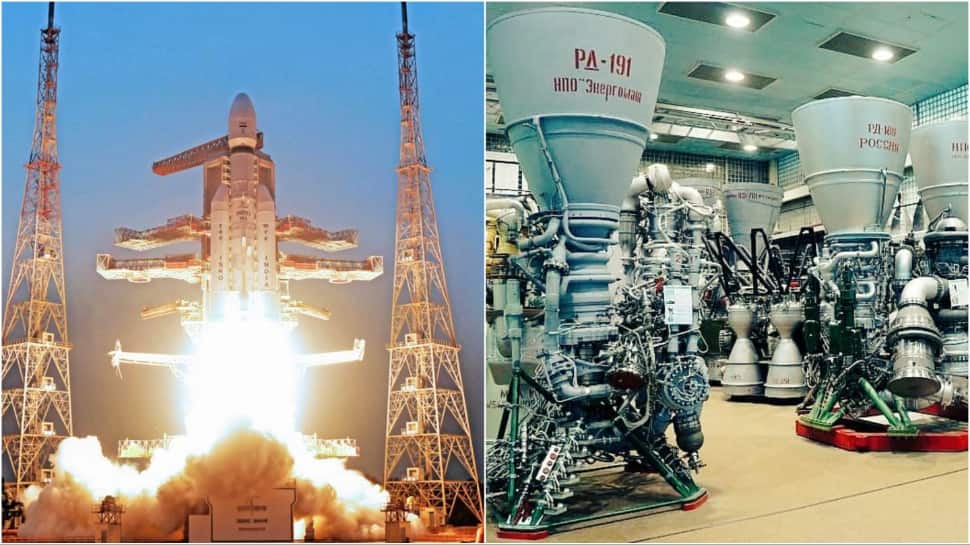
In a major development that marks a new high in Indo-Russian defense and space cooperation, Moscow has agreed to a 100% Transfer of Technology of its highly advanced RD-191M semi-cryogenic rocket engine to the Indian Space Research Organisation. The deal, if finalized, would prove to be a monumental leap for the latter’s space program.
Here is a breakdown of why this technology transfer is critical to India’s space ambitions:
Understanding The RD-191M Engine
The RD-191M is an advanced semi-cryogenic engine from Russia. Semi-cryogenic engines do not use liquid hydrogen and liquid oxygen, like full cryogenic ones; instead, they operate using Liquid Oxygen (LOX) as the oxidizer, with refined Kerosene, RP-1, as fuel.
The signature feature of the RD-191M is its enormous power: a single engine is estimated to develop around 192 tons of thrust. Currently, Russia uses a variety of engines from this family to power its advanced Angara series of rockets.
Strategic And Operational Benefits For ISRO
ISRO intends to use this latest technology to further boost its heavy-lifting operational rocket called the Launch Vehicle Mark-3, popularly known as the GSLV Mk3. The LVM3 now carries an indigenously developed cryogenic engine, the CE-20, powering its upper stage, but using powerful semi-cryogenic engines such as the RD-191M in its core or lower stages will boost the rocket’s overall lifting capability.
This strategic upgrade will considerably reduce India’s dependence on foreign space agencies for launching its heaviest satellites. The move will also strengthen its position in the commercial space market, as ISRO will be able to launch heavy payloads for other countries and thereby earn a lot of economic benefits.
Massive Boost In Payload Capacity
The integration of the RD-191M technology is expected to provide an immediate and substantial performance upgrade to India’s launch vehicles.
Current Capacity: Currently, the LVM3 is capable of carrying around 4.2 tons of payload to Geostationary Transfer Orbit.
Future Capacity: The GTO payload capacity is foreseen to increase substantially with the RD-191M engine technology to between 6.5 and 7 tons, an additional lifting capability of roughly 2.5 to 3 tons per launch.
The increased capacity is essential for deploying next-generation heavy communication satellites and for undertaking ambitious interplanetary missions like future Chandrayaan expeditions and the human spaceflight program, Gaganyaan.
Domestic Manufacturing And Timeline
A critical part of this deal is the fact that it would realize the vision of ‘Make in India’ in high-tech space manufacturing. The media reports that these engines would be produced in the country. HAL and ISRO would engage in the making of a new, dedicated production facility for these engines.
With 100% technology transfer, India will not only achieve self-reliance in this critical domain but will also gain the potential to export these sophisticated engines to other countries in the future. This will place India in the elite league of nations, alongside Russia, the United States, and China, which have the capability to develop semi-cryogenic engines.
Looking Ahead (2026-2030) Final negotiations between the two countries are in progress. The technology transfer is likely to begin by around 2026-27. ISRO plans to have India’s fully realized semi-cryogenic engine ready by 2030. ISRO scientists are very optimistic about the development, as, according to them, RD-191M will give India’s future heavy-lift rocket capabilities and human space programs a quick impetus.
ALSO READ | Putin Arrives Today: PM Modi Dinner Kicks Off High-Stakes Talks On Su-57 Fighters & Sanctions Workarounds | Know Itinerary
About the Author