India-Russia Strategic Partnership: Operation Sindoor demonstrated India’s battlefield precision, which was supported in large part by its long-standing ally, Russia. From supersonic BrahMos missiles to S-400 air defence systems and advanced fighter jets, decades of Indo-Russian defence collaboration played a decisive role in giving India the upper hand.
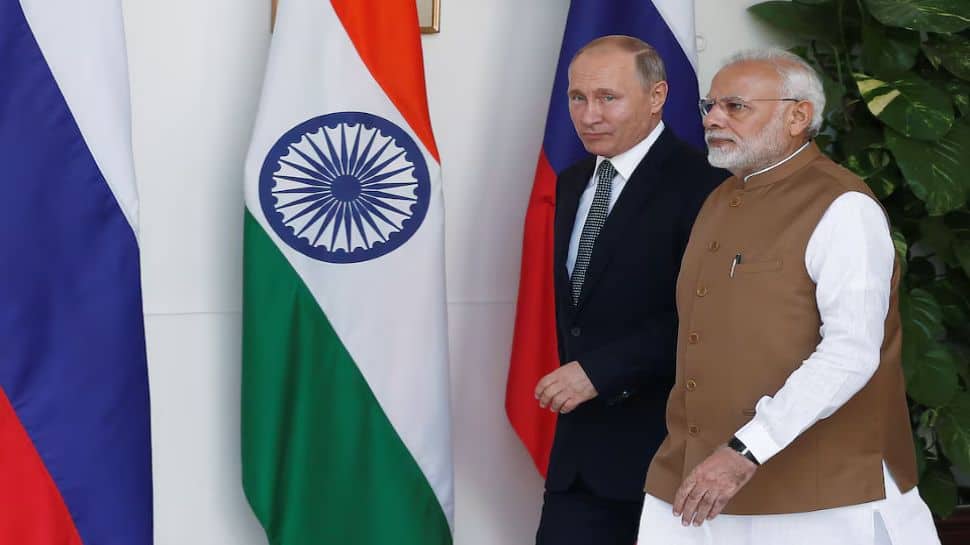
The strategic partnership is set to take centre stage once again when President Vladimir Putin arrives in New Delhi on December 4-5 for his meeting with Prime Minister Narendra Modi. Discussions are expected to include the next phase of India’s ambitious Sudarshan Chakra project, the homegrown ‘Indian Iron Dome’, along with potential procurement of additional S-400 surface-to-air missile systems, a platform that proved highly effective during India’s recent military offensive against Pakistan.
New Delhi’s defence ties with Moscow form a long-standing collaboration. In the 1970s, the Indian Air Force (IAF) relied on Russian SAM-2 missiles. The MiG series of aircraft (MiG-21, MiG-23, MiG-27, MiG-29 and MiG-25) along with T-90 tanks have supported India’s defence preparedness for decades.
Over time, this relationship evolved from a simple buyer-seller dynamic into a strong technology partnership. Over the last two or three decades, the cooperation has moved from basic procurement to joint development, resulting in advanced systems such as the BrahMos missile.
Named after the Brahmaputra and Moscow rivers, the BrahMos system delivered a standout performance during Operation Sindoor. The pinpoint accuracy with which India struck targets in enemy territory was made possible by BrahMos’s unmatched supersonic capabilities.
Equally crucial was the newly inducted S-400 air defence system from Russia. It was used extensively to counter incoming missiles and drones. Its integrated radar and electronic warfare systems created a near-impenetrable shield that kept enemy aircraft far from Indian airspace.
On the offensive front, Sukhoi fighter jets, manufactured in India under Russian licence, carried out important strike missions. As one of the main pillars of India’s air arsenal, the Sukhois played an important role during direct attack operations.
The India-Russia partnership extends well beyond conventional security. It spans nuclear energy, space exploration and submarine development. Russian reactors fuel India’s civilian nuclear programme, joint space projects have enabled satellite launches and advanced research and submarine collaboration continues to strengthen India’s maritime security.
Today, several Indian industries are working with Russian firms on critical defence technologies, further enhancing strategic capabilities.
As global uncertainties grow, India’s reliance on Russia as a trusted partner remains steady. This remains one of India’s most dependable strategic relationships, proven repeatedly over time.
Operation Sindoor stands as more than a tactical achievement. It is a reflection of decades of enduring friendship. From the Moscow River to the Brahmaputra, the Indo-Russian bond continues to power missiles, energise reactors and safeguard India’s skies.
About the Author