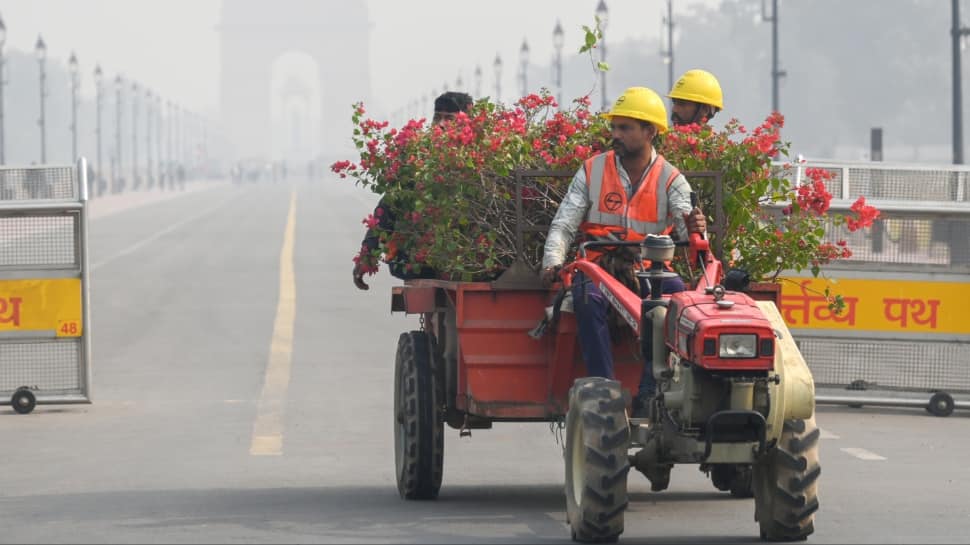
Delhi’s air quality sharply deteriorated on Tuesday evening, with a rapid climb in pollution levels pushing several neighborhoods back into the hazardous ‘severe’ category. The sharp decline marks an end to a brief period of relatively cleaner air and signals a worrying trend for the national capital’s air quality.
Hazardous Spike Across The Capital
Data from the Central Pollution Control Board showed the national capital recording an average Air Quality Index (AQI) of 390 by 9 pm Tuesday, a significant jump from 304 recorded on Monday and 279 on Sunday.
The hazardous return was visible across the city, with 19 out of 39 monitoring locations recording AQI levels above the 400-mark, indicating conditions classified as ‘severe’ and known to cause serious health impacts. Areas particularly affected included Burari, Mundka, Vivek Vihar, Rohini, Punjabi Bagh, and Anand Vihar.
By 8 pm on Tuesday, several monitoring stations across Delhi registered ‘severe’ Air Quality Index (AQI) levels, indicating highly hazardous conditions.
The most polluted area was Chandni Chowk, recording an alarming AQI of 471. Other severely impacted neighborhoods included Nehru Nagar (446), Bawana (438), Vivek Vihar (437), and Wazirpur (433).
Areas like Okhla Phase 2 (431), RK Puram (426), Anand Vihar (421), Rohini (420), and Ashok Vihar (418) also saw their AQI breach the 401–500 range, which the Central Pollution Control Board (CPCB) classifies as ‘severe’.
Transport Remains Biggest Local Contributor Despite ongoing efforts, emissions from the transport sector accounted for the single largest local source of pollution in Delhi on Tuesday, contributing 18.4% to the city’s total emissions, news agency PTI reported.
Emissions from peripheral industries came a close second at 9.2%. The contribution from the NCR-neighbor cities, including Noida-8.2%, Baghpat-6.2%, Ghaziabad-4.6%, Panipat-3.3%, and Gurugram-2.9%, continuously adds to the crisis.
Outlook: No Immediate Relief In Sight
The Delhi Air Quality Early Warning System has warned locals that improvement in air quality is not very likely anytime soon. According to the forecast, the city’s AQI will continue in the “very poor” category at least till December 5 and pollution levels are expected to stay in the same category for the next six days. The share coming from the transport sector will remain high as well, at 15.6% on Wednesday, according to projections.
ALSO READ | Security Tightened At BHU Following Violent Confrontation Between Students And Officials
About the Author