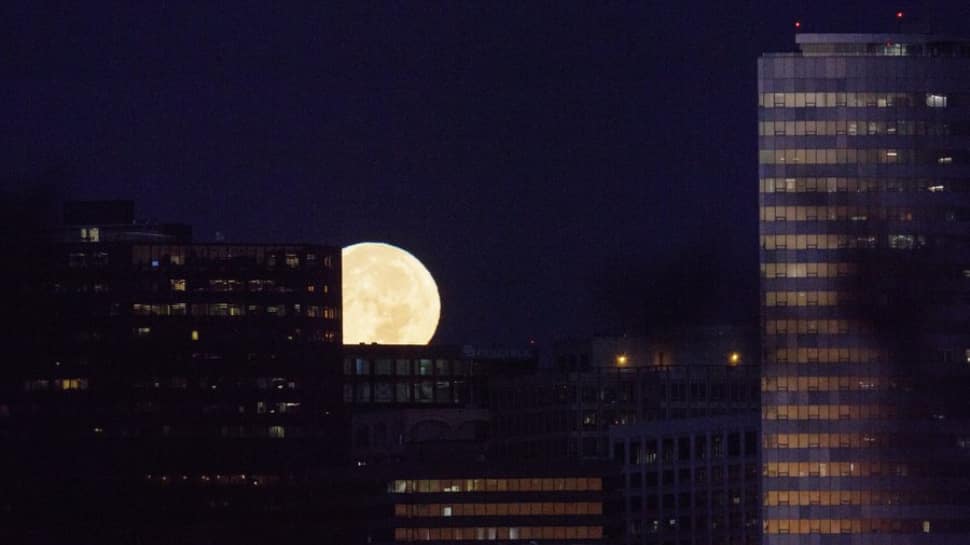
Skywatchers have a special reason to look up yesterday, NASA has shared a stunning view of the final full Moon of the year, popularly known as the Cold Moon Or Super Moon. This celestial event is even more remarkable because it appears as a supermoon, glowing bigger and brighter than usual as it reaches its closest point to Earth.
The Last Full Moon of the Year
The full Moon shining on Thursday, December 4, marks the last full Moon of the year and also appears as a supermoon. A supermoon occurs when the Moon reaches perigee, the closest point in its orbit to Earth, making it look slightly larger and more luminous in the night sky.
NASA shared the photo of the full Moon with the caption:
“Look up at the Moon tonight — it’s the last full Moon of the year!
The full Moon on Thursday, Dec. 4, will also be a supermoon, appearing slightly bigger and brighter than usual because it’s at the point in its orbit closest to Earth.”
Look up at the Moon tonight—it’s the last full Moon of the year!
The full Moon on Thursday, Dec. 4 will also be a supermoon, when the Moon looks a bit bigger and brighter than usual because it’s at the point in its orbit nearest to Earth. pic.twitter.com/KBu4tbzdSq
— NASA Earth (@NASAEarth) December 4, 2025
What Is a Supermoon?
A supermoon takes place when a full Moon coincides with perigee. Because the Moon follows an elliptical orbit, its distance from Earth ranges from about 407,000 km at apogee (the farthest point) to roughly 380,000 km at perigee (the closest point).
This December 4 supermoon is the third consecutive supermoon of 2025, positioned approximately 357,000 km away from Earth. This makes it the second closest full Moon of the year, causing it to appear up to 8% larger and nearly 16% brighter than an average full Moon. It will also reach full illumination just 12 hours after perigee, enhancing its visual brilliance.
Previous Cold Moons of 2025
In 2025, Cold Moons have already appeared earlier on October 7 and November 5. The December 4 full Moon completes the trio of Cold Moons observed this year.
Why December’s Full Moon Is Called the Cold Moon
The December full Moon earns the name “Cold Moon” because it aligns with the time of year when temperatures drop sharply. As the last of the 12 full moons in 2025, it also reaches the highest point in the sky. With the winter solstice arriving on December 21, the Sun sits at its lowest altitude, causing the Moon to appear higher and brighter.
Although striking, this full Moon is not the closest one to the solstice. That distinction goes to the first full Moon of 2026, appearing 17 days later on January 3, which will be the fourth and final consecutive supermoon.
As the last Cold Moon of 2025 lights up the sky, it marks the end of a remarkable lunar year filled with multiple supermoons and breathtaking celestial moments. Stargazers are encouraged to enjoy this spectacular display, as the next supermoon will illuminate the night early in 2026. Whether viewed through a telescope or with the naked eye, tonight’s Cold Moon is a stunning reminder of the beauty of our ever-changing sky.
About the Author