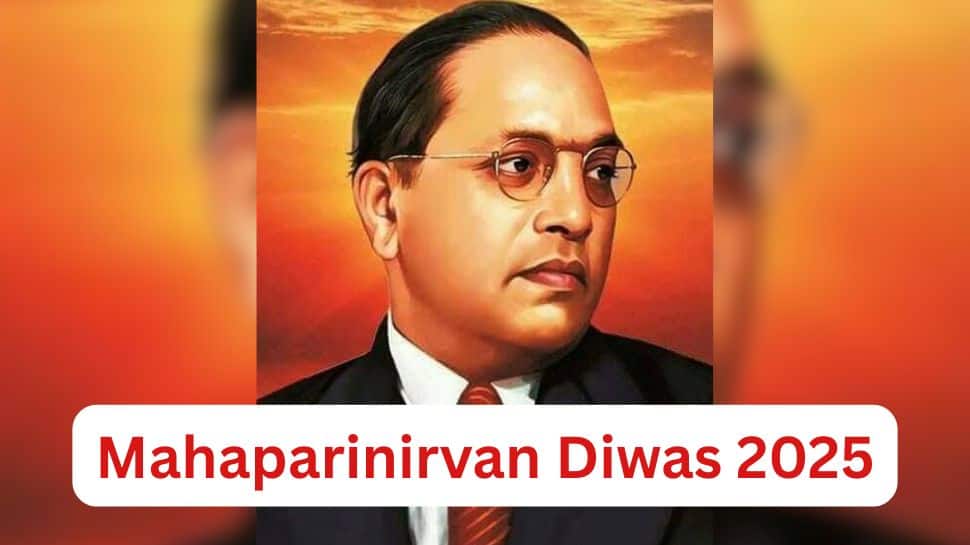
Mahaparinirvan Diwas 2025: December 6, 2025 marks the death anniversary of Dr Bhimrao Ramji Ambedkar, the principal architect of the Indian Constitution and a lifelong champion of social justice. The day signifies his journey into eternal peace while celebrating his powerful contributions towards uplifting marginalised communities and promoting equality and human rights.
Mahaparinirvan Diwas is observed as a time for reflection and gratitude, reminding us of Dr Ambedkar’s unwavering commitment to building a fair and inclusive society. It inspires people to continue working towards social justice and the values he stood for.
Who is Dr B. R. Ambedkar?
Dr B. R. Ambedkar was an Indian jurist, economist, social reformer, and the chief architect of the Indian Constitution. He dedicated his life to fighting caste discrimination and worked tirelessly for the rights of Dalits and other marginalised communities. As the chairman of the Drafting Committee of the Constituent Assembly, he played a key role in shaping modern India’s democratic and constitutional framework.
Legacy of Dr Bhimrao Ramji Ambedkar
Dr. B.R. Ambedkar, born on April 14, 1891, devoted his life to ending caste discrimination. He worked for the rights of Dalits, women and labourers, and pushed for reservations in education, jobs and politics. Through his newspaper Mooknayak and the Bahishkrit Hitkarini Sabha, he promoted equality and social justice.
Ambedkar led key movements like the Mahad Satyagraha and the Kalaram Temple entry struggle. He played a major role in the Poona Pact, securing reserved seats for Dalits. His research helped shape the Finance Commission and guided the RBI Act, 1934.
As chairman of the Constitution Drafting Committee, he was central to creating the Indian Constitution, which remains the foundation of India’s democracy.
Must-Read Books By Dr. B.R. Ambedkar
Annihilation of Caste (1936): This is Ambedkar’s most famous work, originally written as a speech he could not deliver. It is a fearless critique of the caste system and its religious foundations, arguing that social reform alone cannot achieve equality unless caste hierarchies are abolished. The book remains a cornerstone for understanding Ambedkar’s vision of social justice and equality.
The Buddha and His Dhamma (1957): In this book, Ambedkar interprets the life and teachings of Buddha as a path to social equality, rational thinking, and moral living. He presents Buddhism as not just a religion but a philosophy that opposes caste discrimination and promotes human dignity.
The Problem of the Rupee: Its Origin and Its Solution (1923): This is Ambedkar’s major economic work, focusing on India’s monetary system during British rule. He analyzed the causes of India’s economic problems and proposed solutions for currency reform, which later influenced the establishment of financial institutions like the Reserve Bank of India.
Inspirational Quotes By Dr. B.R. Ambedkar
“Life should be great rather than long.”
“Caste is not just a division of labour, it is a division of labourers.”
“Democracy is not a form of government, but a form of social organisation.”
“Educate, Agitate, Organise.”
“Freedom of mind is the real freedom. A person whose mind is not free, though he may not be in chains, is a slave, not a free man.”
About the Author