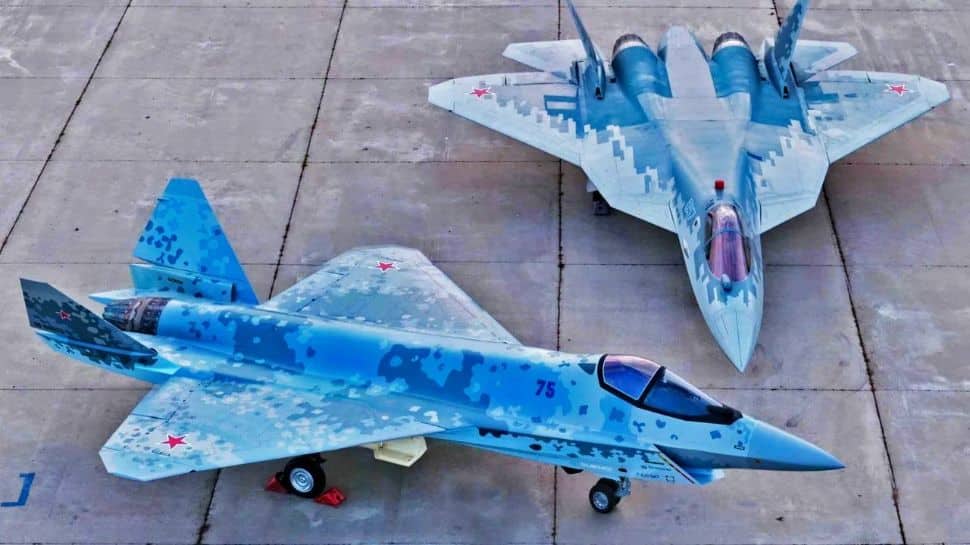
New Delhi: Launched in 2021 as Russia’s affordable answer to the F-35 of the United States, the Su-75 “Checkmate” was designed to offer stealth features, modern sensors and strong export potential. Four years later, the aircraft remains largely imaginary. It exists as a sleek model, glossy brochures and confident statements about a prototype that is always scheduled to fly “next year”. In reality, it has not moved beyond the stage of a concept.
This is not because of a lack of ambition. Russia’s military-industrial system has been worn down by sanctions, drained by the war in Ukraine and stretched thin by the constant need to repair losses and keep older aircraft flying. Production lines that might once have supported a clean-sheet stealth programme are now focussed on refurbishing Soviet-era platforms, assembling drones and turning out low-cost munitions in large numbers.
A country that has to smuggle basic microelectronics and machine tools through complex sanctions-evasion networks is in no position to field a next-generation fighter. The Su-75 has become less of a development project and more of a signal to foreign audiences that Russia still belongs at the top table of military aviation, even though conditions on the ground tell a very different story.
What Moscow Needed The Su-75 To Achieve
The Checkmate was supposed to rescue Russia’s shrinking position in the global fighter market, demonstrate innovation under pressure and offer a vision of affordable mass production in an era of artificial intelligence and autonomous warfare.
Rosoboronexport has watched its export business weaken as the Ukraine war exposed flaws in Russian systems. Aircraft that once seemed formidable are now being shot down at rates that would have been shocking just a few years ago.
Inside Russia’s aerospace sector, engineers have left, supply chains have fractured and investment has dried up. The Su-75 was meant to reverse this decline. It was meant to show momentum.
Momentum, however, requires physical reality. It requires factories capable of producing advanced composites, reliable engines, secure avionics and trusted software. Moscow cannot deliver these at the necessary scale. Ambition has raced far ahead of capacity, leaving the Su-75 in the same category as the T-14 Armata tank, which too witnessed a spectacular rollout followed by near-total operational absence.
War Has Redirected Every Priority
The war in Ukraine has consumed the future of Russian military aviation. Facilities that could have been used to test a new stealth aircraft are now busy keeping aging fleets in the air and producing incremental upgrades. The limited resources available are going toward glide bombs, cruise missiles and drones rather than flight-testing a risky new jet.
Even the Su-57, which was intended to be Russia’s flagship fifth-generation fighter, remains in low-volume boutique production. Against this backdrop, the Su-75 is not only delayed but effectively sidelined.
High-intensity war clarifies priorities. Russia is now focussed on survivability, volume and low-cost lethality. A clean-sheet stealth fighter requires an ecosystem Russia no longer controls. The Checkmate does not fit the battlefield logic that currently dominates Moscow’s thinking.
Export Dreams Have Nowhere To Land
There is still an idea in some circles that foreign buyers could rescue the programme. In reality, there are no export orders for an aircraft that cannot fly. Potential customers such as India, Vietnam and the United Arab Emirates have watched Russia struggle with manufacturing and technology. They have studied how Russian aircraft perform over Ukraine. They have drawn their own conclusions.
Modern fighter procurement is not only about sticker price, but about long-term maintenance, control over software and industrial partnerships that provide strategic insurance. No serious air force wants to anchor itself to a platform that cannot be reliably supported in war or built at scale in peace.
The Su-75 offers only risk, which includes delayed delivery, fragile supply chains and dependence on an economy cut off from high-end components. It is a risky bet with no realistic upside.
Russia’s Real Breakthrough Happened Elsewhere
If there is a true Russian innovation story in this war, it does not involve sleek stealth jets. It lies in drones, electronic warfare and the revival of simple and mass-produced weapons.
Moscow has embraced attrition as doctrine. The goal is to saturate, exhaust and overwhelm. Swarms of UAVs, loitering munitions and improvised battlefield networks now define the air domain. In that world, a boutique stealth fighter has little relevance.
Seen through this lens, the Su-75 is not a delayed project. It is a relic of a different era of thinking, a vision of airpower that no longer matches the realities of modern warfare as Russia is now practicing it.
A Programme Trapped By Its Own Promises
Russian officials still talk about a flying prototype being just months away. But the A prototype does not equal a viable programme. Even if an airframe eventually takes off, moving from a single demonstrator to serial production would demand industrial depth that Moscow simply does not possess.
The Su-75 now appears in a strategic dead end. It is too expensive and symbolic to cancel, but too unrealistic to deliver. It functions primarily as political theatre.
The intent is to project modernity, competence and technological strength. The longer the aircraft fails to appear in the sky, the louder the unspoken message becomes that Russia’s limitation is not design skill but industrial capacity.
A Fighter That Became A Performance
The Su-75 was supposed to be the move that shifted the global chessboard. Instead, it has become a symbol of ambition unsupported by reality.
Russia does not have the supply chains or technological depth to field a fifth-generation export fighter at meaningful scale in this decade, and talk of a global Su-75 fleet in the 2030s belongs more to marketing than manufacturing.
Airshows will likely feature mock-ups for years to come, exhibitions will continue and presentations will remain confident, but the Checkmate is not a working prototype. It exists mainly as a performance.
About the Author