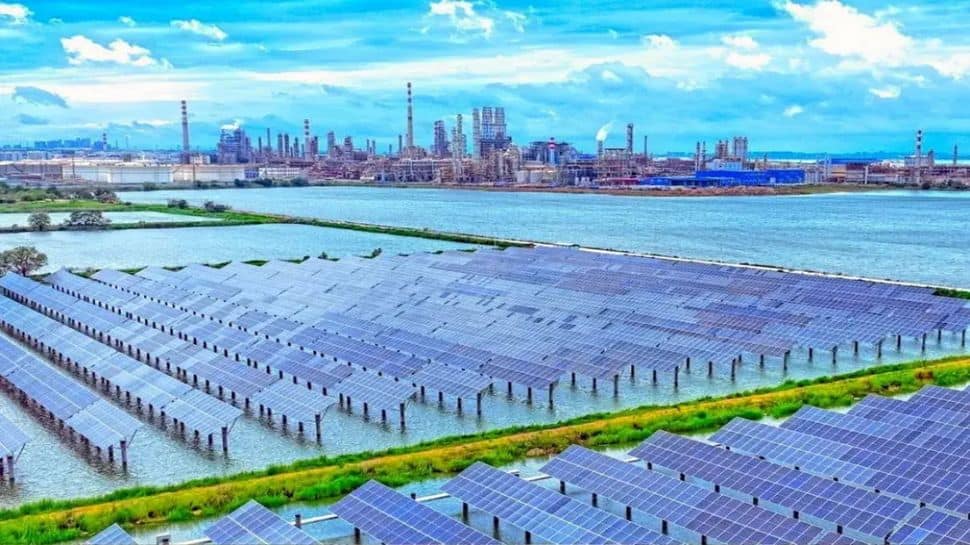
Beijing: A breakthrough in China has created a buzz across the global energy and water industry. A newly launched facility in Shandong’s Rizhao city has shown that seawater costing just Rs 24 per cubic metre can be converted into both drinking water and clean fuel in a single process. Scientists describe it as a turning point, while economists are calling it one of the most disruptive innovations of the decade.
The project has drawn worldwide attention because it uses a single machine to create two precious resources, which are ultra-pure drinking water and green hydrogen. Both are produced using nothing more than seawater and the waste heat released from nearby steel and petrochemical plants.
For countries struggling with water shortages and rising fuel costs, this development is being seen as an example of what the future may look like.
According to a report in the South China Morning Post, this is the first facility of its kind anywhere in the world. It runs entirely on seawater and the excess heat that factories used to release into the air. Instead of letting that energy disappear, engineers at the plant redirect it to power a system that turns the ocean into a source of fresh water and clean fuel. The design works on the principle of one input and three outputs.
One Input, Three Outputs
The single input is seawater combined with waste heat. From that, the system delivers three different outputs.
First, it produces drinking-grade water. Each year, 800 tonnes of seawater are processed to generate 450 cubic metres of ultra-pure water that can be used in homes, laboratories or industries.
Second, it produces green hydrogen, about 1,92,000 cubic metres every year. This is considered one of the cleanest fuels on earth and can power anything from buses to industrial plants.
Third, the process leaves behind 350 tonnes of mineral-rich brine, a material used to manufacture various marine chemicals. Nothing goes to waste, and every step creates something useful.
Cheaper Than Saudi Arabia, The US
What has startled experts across the world is the cost. China is producing fresh water from seawater at only Rs 24 per cubic metre. In countries like Saudi Arabia and the United Arab Emirates (UAE), which are known for the world’s cheapest desalinated water, the cost is still about Rs 42.
In California’s largest facility, the cost jumps to around Rs 186.
An interesting comparison has come up in China as well. Tap water in Beijing costs 5 yuan, but water made from the sea in this plant costs only 2 yuan. Engineers say this difference shows how significantly the new process reduces expenses.
A Fuel Cheaper Than Petrol?
Hydrogen has long been considered the fuel of the future because it does not create pollution. Until now, the challenge was that producing it required enormous amounts of electricity and very pure water. Saltwater damaged machines, clogged equipment and corroded electrodes.
China’s new setup has bypassed these hurdles by generating hydrogen directly from seawater without using freshwater at all.
The quantity produced at the plant is enough to power 100 buses for nearly 3,800 kilometres each year. Senior engineer Qin Jiangguang of the Laoshan Laboratory explained the scale of the discovery, “This is not only about filling hydrogen cylinders. It is a new way of extracting energy from the sea.”
Corrosion Problem Finally Solved
One of the biggest technical obstacles in producing hydrogen from seawater has been corrosion. Minerals such as magnesium, calcium and chloride ions damage equipment or settle on electrodes. But the Rizhao facility has been running nonstop for three weeks without a single interruption, proving that the team has found a workable solution.
For coastal nations facing water scarcity and limited energy sources, this breakthrough offers a ray of hope. Countries with long shorelines but limited freshwater may eventually use the ocean not only as a water source but also as a source of clean fuel.
About the Author