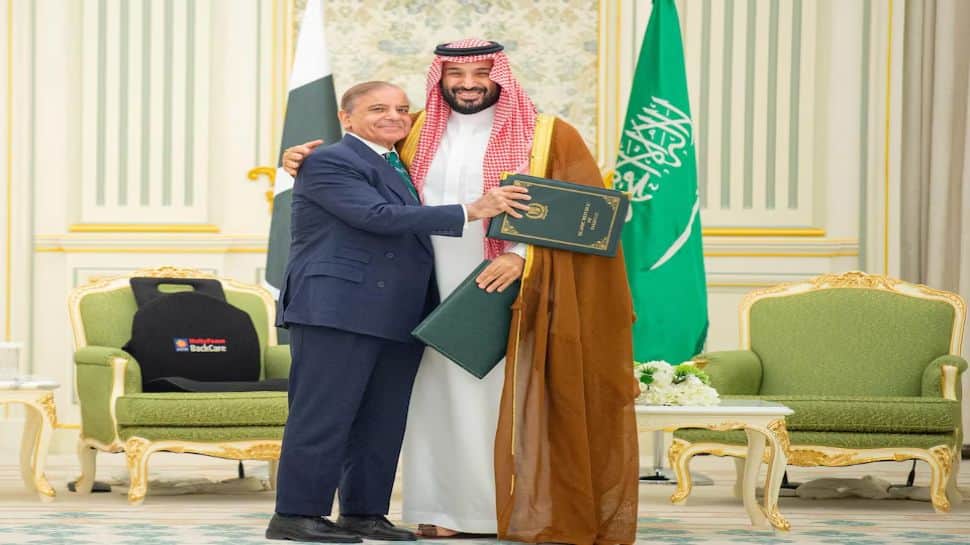
New Delhi: The shockwaves of Israel’s attack on Qatar were felt across the Gulf. Only eight days later, Saudi Arabia and Pakistan signed a nuclear security agreement, raising questions about regional security dynamics. Under the deal, any attack on either country would be considered an attack on the other.
American expert Jean Loop sees this move as closely linked to the Qatar incident, especially since Qatar was under US security guarantees at the time.
“This pact is more significant for India’s interests in the Gulf than it is for the United States,” he said, adding that analysts quickly began viewing it as a challenge to India’s influence.
A Longstanding Relationship
In an article for the Atlantic Council, Loop explained that the Saudi-Pakistani relationship itself is not new. Both countries have historically shared close ties in labour and security. Riyadh has long relied on Pakistani troops for military training, with Pakistan Army deployed in the Kingdom since 1963. These troops safeguard key locations, including Mecca and Medina.
In the 1980s, Saudi Arabia, Pakistan and the United States cooperated to train Afghan militants against the Soviet Union. Saudi Arabia has also supported Pakistan’s nuclear weapons programme.
India’s Presence In The Gulf
He highlighted that Pakistan’s influence has historically limited India’s reach in the Gulf. At present, around 9.7 million Indians reside in six Gulf countries. In 2024, India received $47 billion in remittances from the region.
Since Prime Minister Modi’s engagement with the Gulf, India has positioned itself as a strategic player. Stronger ties with the UAE and high-profile visits by Saudi Crown Prince Mohammed bin Salman have bolstered India’s role. Talks have included trade, counter-terrorism and maritime security.
Gulf Nations Leaning Toward China
Relations between Saudi Arabia and Pakistan had soured in 2015 when Pakistan refused to support Saudi-led military operations in Yemen. This led both Saudi Arabia and the UAE to change their strategic bets, increasingly engaging with China rather than India.
Gulf countries, including Saudi Arabia, Qatar and the UAE, have purchased missiles and advanced drones from China. Chinese naval presence has also begun in Oman, only 2,084 km from India, adding to New Delhi’s strategic concerns.
Is India Losing Ground?
Loop explained that Gulf nations still see India primarily as a regional Asian power, not a global one. They value India for investment opportunities and regional cooperation but view China as a global power, with Pakistan as its close ally. According to him, India lacks a clear West Asia policy; whereas, China focusses on trade and investment while avoiding domestic entanglements.
“India had hoped, with the US support, to channel Europe-Gulf trade corridors through Saudi Arabia and the UAE, but the Gaza conflict disrupted those plans,” he said.
With Gulf nations strengthening ties with China and Pakistan, initiatives such as the Belt and Road will gain momentum over India’s European corridor ambitions.
After the Saudi-Pakistan defence deal, India promptly issued a statement, reminding Saudi Arabia of India’s “sensitivity” regarding regional security concerns.
About the Author