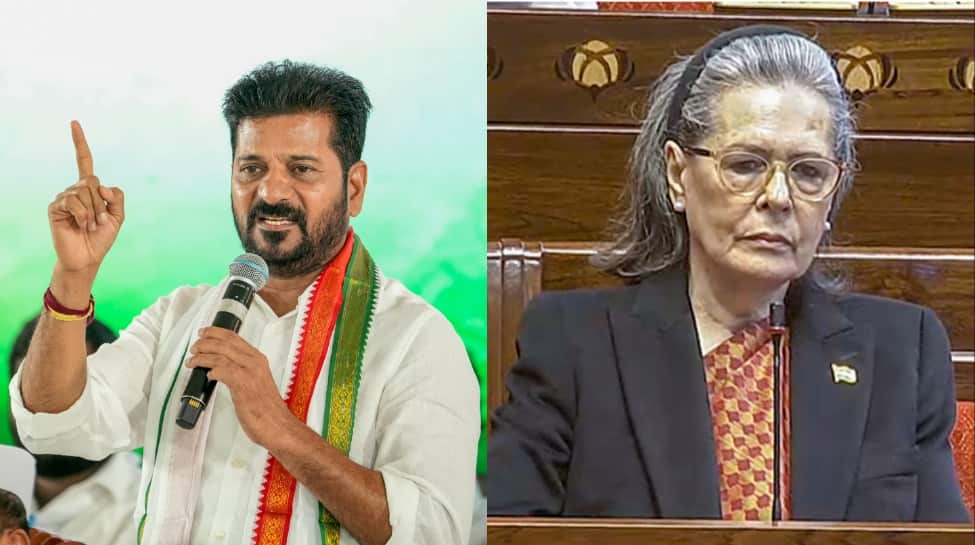
Aggression has been central to Revanth Reddy’s political rise in Telangana. It is also shaping his approach as Chief Minister. When he said that Sonia Gandhi’s “sacrifice” made it possible for Christians to celebrate Christmas in Telangana, the remark was not a slip of the tongue or mere flattery. It was a deliberate political signal.
The comment instantly sparked controversy. The BJP dismissed it as “Olympic-level sycophancy and boot-licking,” arguing that it insulted Jesus Christ and the Christian community, and sarcastically suggesting the Congress might next claim that the sun rises because of the Gandhi family. The BRS, meanwhile, described the statement as political theatre and circulated old videos from Revanth Reddy’s days in the Telugu Desam Party, when he had allegedly referred to Sonia Gandhi as “Bali Devatha” (deity of sacrifice), blaming her for the deaths of young people during the Telangana statehood movement.
At the heart of the row was Reddy’s assertion, “If people are celebrating Christmas in Telangana today, it is because of Sonia Gandhi’s sacrifice.”
This was not an isolated comment. A month earlier, during the high-stakes Jubilee Hills by-election, Reddy had told Muslim voters, “Hum hain toh aap hain” (You exist because we exist), and suggested that Muslims were able to celebrate their festivals because of the Congress. That remark, too, generated sharp reactions.
Taken together, these statements point to a clear strategy. Reddy is not merely trying to please minorities or signal loyalty to the party leadership. He is attempting to redraw the political equation around minority votes in Telangana, traditionally dominated by the BRS’s welfare-based outreach and the AIMIM’s identity-driven politics.
Under K Chandrashekar Rao, the BRS followed a model centred on welfare schemes such as Shaadi Mubarak, treating minorities largely as beneficiaries of state support. It was a top-down approach focused on financial assistance rather than political assertion. Reddy is moving away from that framework.
Instead, he is positioning the Congress as a protector. By linking the celebration of religious festivals and even the “existence” of minorities to the Congress, he is framing the party as a shield against the BJP, warning that under a BJP-led order, even basic rights and freedoms could be under threat.
In this narrative, the Congress is no longer just another “secular” option. It is projected as an “aggressive protector” willing to confront majoritarian politics head-on. Invoking Sonia Gandhi’s role in the creation of Telangana is meant to underline the party’s willingness to take political risks for what it claims are principled decisions. The implied message is that minorities owe more than transactional loyalty; they should see Congress as the architect of their security and rights.
This approach also challenges the long-standing role of the AIMIM, which has positioned itself as the primary voice of Muslims in Telangana. While the party has influence, it lacks the numbers to govern the state and has often functioned as a tactical ally of the BRS. Reddy’s strategy seeks to end what he sees as the outsourcing of minority leadership by bringing minority politics directly under the Congress umbrella.
The proposed caste census in Telangana fits into this plan. By appealing to backward or Pasmanda Muslims and Christians, the Congress is signalling that political power can be achieved through social justice and representation, rather than through religion-based mobilisation. This echoes an earlier attempt by former Chief Minister Y S Rajasekhar Reddy, which was later struck down by the Supreme Court.
Reddy is also backing his rhetoric with policy proposals. He has promised legislation to act as an anti-hate safeguard, drawing parallels with a similar law introduced in Karnataka. The idea, as he presents it, is that the state itself will step in as a protector when faith is insulted or targeted.
This marks a departure from the BRS’s cautious approach, which largely avoided confrontation on communal issues to preserve a neutral image. Reddy, by contrast, is openly taking sides and proposing legal measures against what he calls insults to faith, making both the BRS and AIMIM appear restrained by comparison.
His reference to a “Miracle Month”, linking the birth of Jesus, Sonia Gandhi’s birthday and the formation of Telangana, was designed to strike an emotional chord. It reinforces the argument that the Congress honoured its promise on statehood despite political costs, particularly in Andhra Pradesh, and that it would show similar resolve in protecting minorities.
What Reddy is betting on is a shift in minority expectations. In his view, rising Hindutva politics means minorities will no longer be satisfied with symbolic secularism or welfare alone. They will look for a party that can assertively defend and mainstream them.
Telangana, under Revanth Reddy, is emerging as a testing ground for this new Congress strategy, one the party may seek to replicate nationally if it believes the experiment succeeds.
About the Author