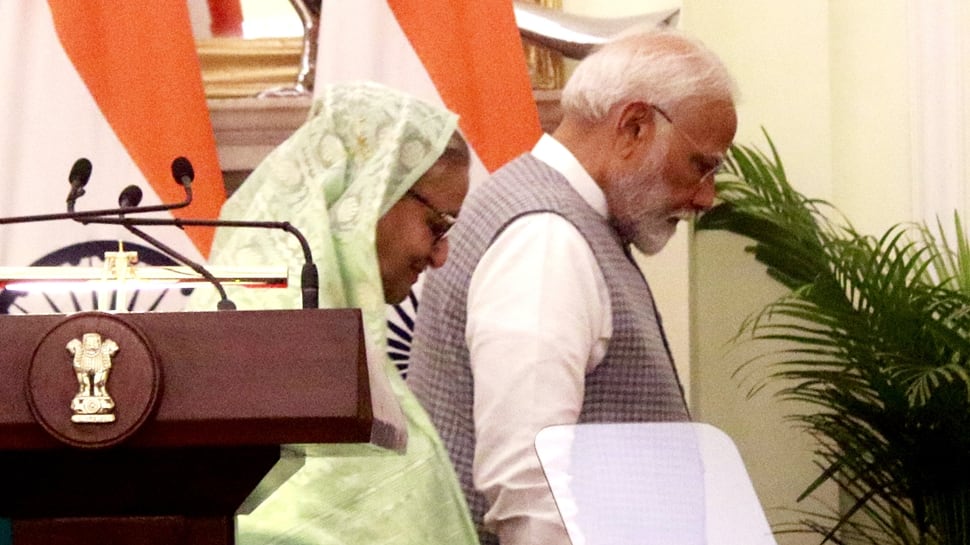
India-Bangladesh Ties: Political tensions are high, and Islamist radicals are holding rallies echoing anti-India sentiments across Bangladesh. The Bangladesh student protest that toppled the Sheikh Hasina government has now taken an anti-India turn under the interim government led by Muhammad Yunus. No one is talking about reforms or general elections, but the majority of the leaders in Bangladesh appear more concerned about cashing in on the anti-India sentiments rather than resolving domestic turmoil.
However, Hasina has blamed the Yunus Government for the strained ties with India. Former Bangladesh Prime Minister Sheikh Hasina believes that the stressed relations between India and her country are completely of the making of the interim government headed by Mohammad Yunus. She accused the Yunus government of issuing hostile statements against India and failing to protect religious minorities.
“The strain you are witnessing is entirely of Yunus’ making. His government issues hostile statements against India, fails to protect religious minorities, and allows extremists to dictate foreign policy, then expresses surprise when tensions rise. India has been Bangladesh’s most steadfast friend and partner for decades. The ties between our nations are deep and fundamental; they will outlast any temporary government. I am confident that once legitimate governance is restored, Bangladesh will return to the sensible partnership we cultivated over fifteen years,” Hasina told ANI.
Amid the ongoing tension, the voices in India are also being raised from several quarters, with people questioning the Indian Government over their decision to provide asylum to Sheikh Hasina. Many critics are of the opinion that by hosting Hasina, India has closed the doors of negotiations or revival of ties with Bangladesh. Dhaka has urged India to deport Hasina on many occasions.
Former diplomat KP Fabian also favoured the argument. “By keeping Sheikh Hasina here, India has made it difficult to have good relations with Bangladesh and has given an opportunity to those who want to spoil the relations. What India should have done is that, when she came first, it was right to extend asylum at that time. But very soon, India should have found another place for her in another country.”
Fabian also highlighted the fact that while India and Bangladesh have a treaty barring any political extradition, Dhaka thinks that she is a criminal and must face the rule of law there.
However, other former diplomats disagreed with the notion. Veena Sikri, former Indian High Commissioner to Bangladesh, told during an ORF seminar that India acted rightly as a friend of Hasina while others failed her.
Sikri said that friends don’t act against each other. “If you had a very good friend whom you have given shelter to in your house, and somebody surrounds the house and tries to knock down the gate, what would you do? You offer up your friend as bait? No, I’m sorry. That’s not India’s credibility. That’s not how foreign policy operates. The dilemma, honourable Dalai Lama, His Holiness, and been here for more than five decades. So, thick and thin, a friend is a friend. Let’s not forget there are some things beyond just foreign policy rhetoric,” she said.
She also highlighted the fact that Hasina’s son thanks Prime Minister Narendra Modi for giving protection to Hasina while noting that none of the 50 Islamic nations offered help to the family.
Kanwal Sibal, former Indian ambassador, also said disagreed with the claim that India should deport Sheikh Hasina to have better relations with Bangladesh. “By this logic, we should have encouraged the Dalai Lama also to seek asylum elsewhere in order to have better relations with China,” he wrote on X.
While India has been engaging with Bangladesh diplomatically, it also needs to look towards its interest amid threats emanating from Dhaka’s soil, feel experts. As Bangladesh navigates an uncertain transition, the trajectory of its ties with India will be shaped not by rhetoric or resentment, but by the choices its future leadership makes. Whether Dhaka moves toward institutional stability, inclusive governance and pragmatic diplomacy—or allows populism and extremism to define its course—will determine the region’s strategic balance. For India, the challenge lies in safeguarding its interests while remaining open to a reset built on legitimacy and mutual respect.
About the Author