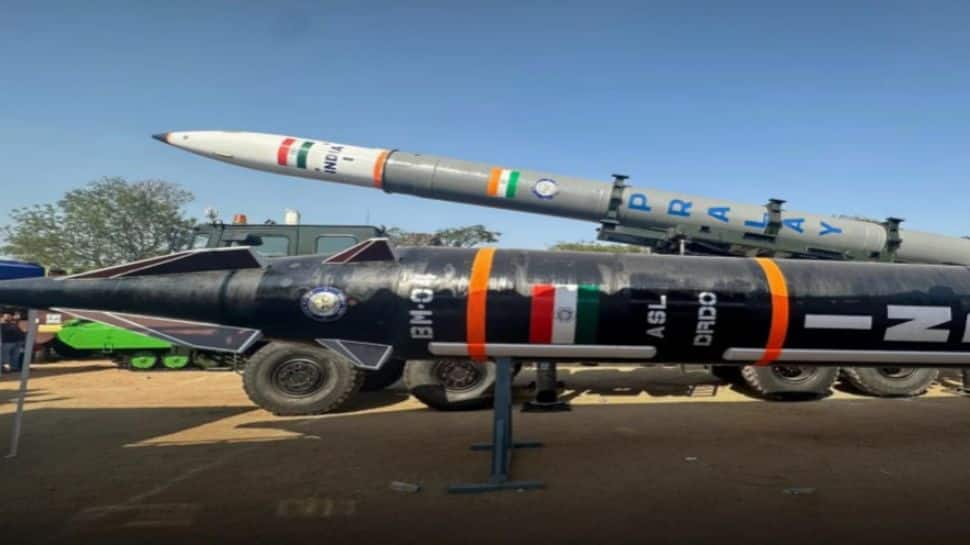
While the Pinaka rocket system operates at much shorter ranges of around 40 to 90 kilometres and the Agni series covers distances well beyond 2,000 kilometres, this ballistic missile fall squarely in between, with a range spanning roughly 400 to 1,500 kilometres.
New Delhi: India’s missile programme has taken a step forward with the Defence Research and Development Organisation (DRDO) receiving approval to develop a new short-range ballistic missile, BM-04. The project has been cleared under the Acceptance of Necessity (AoN) framework, which means full-scale development can now move ahead. Testing is expected to begin soon.
The BM-04 is designed to strengthen India’s conventional strike capability by filling a long-standing gap in the country’s missile arsenal. While the Pinaka rocket system operates at much shorter ranges of around 40 to 90 kilometres and the Agni series covers distances well beyond 2,000 kilometres, this ballistic missile fall squarely in between, with a range spanning roughly 400 to 1,500 kilometres.
Why BM-04 Matters
The new missile is meant to give India the ability to hit high-value targets deep inside hostile territory without crossing the nuclear threshold. Military planners see it as a tool for precise attacks on enemy command centres, air bases and logistics hubs. It is aimed at delivering a strong response using conventional firepower alone.
The BM-04 is expected to boost India’s conventional deterrence and support the country’s emerging Integrated Rocket Force, which aims to streamline and strengthen long-range strike operations.
Features Of The Missile
The missile is expected to weigh around 11,500 kilograms and measure approximately 10.2 metres in length, with a diameter of about 1.2 metres. It will carry a 500-kilogram conventional warhead.
The BM-04 will use a two-stage solid-fuel propulsion system, allowing for quicker launch readiness and simpler handling. For guidance, it will rely on a combination of inertial navigation, GPS and India’s own IRNSS (NavIC) satellite system, enabling high precision. Its circular error probable (CEP) is expected to be under 30 metres.
The missile’s design includes fixed wings and control fins, giving it the ability to manoeuvre during flight and improve its chances of evading enemy air defence systems. It will be stored and launched from a sealed canister mounted on a road-mobile truck, allowing rapid movement, concealment and greater survivability.
A Boost For India’s Defence Posture
Defence experts view the BM-04 as an important addition to India’s non-nuclear strike options. It sends a signal that India can deliver accurate and effective responses using conventional weapons, without immediately escalating to nuclear use.
The DRDO had earlier displayed a model of the BM-04 missile, and with the AoN now in place, the project is moving from concept to reality. Development and testing will gather pace in the coming months, representing another milestone in India’s push for self-reliance in defence technology and a future enhancement of the Indian Army’s operational strength.
About the Author