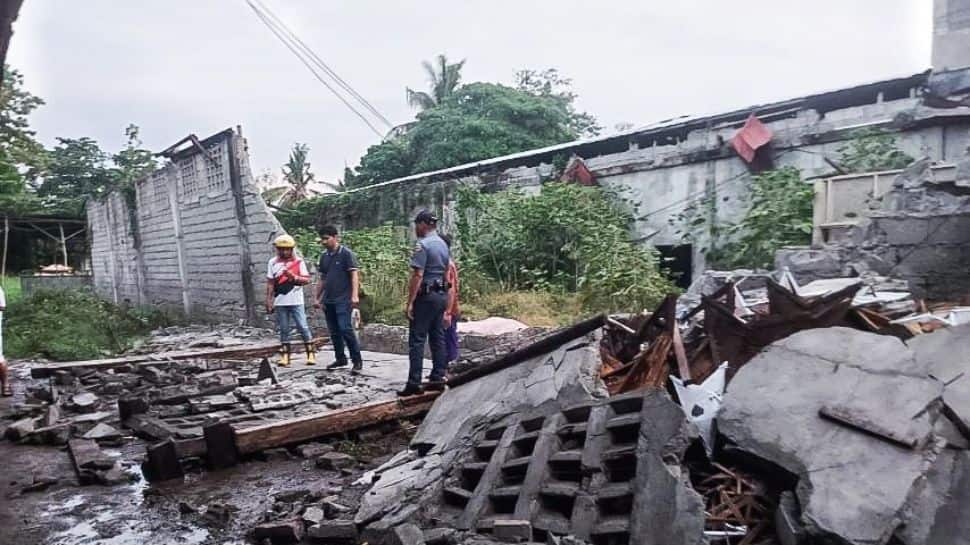
Manila: A strong 6.7-magnitude earthquake struck off the coast of Mindanao Island on Wednesday morning, rattling large parts of the southern Philippines, according to the country’s seismic monitoring agency.
The Philippine Institute of Volcanology and Seismology said the quake occurred at 11:02 am local time at a depth of 42 kilometres, with its epicentre located around 47 kilometres from Manay, a coastal town in Davao Oriental province.
Tremors were felt across several areas of Mindanao, prompting residents to evacuate buildings in some locations. The agency warned that the earthquake could be followed by aftershocks and may cause damage, particularly in communities close to the epicentre, according to Xinhua News Agency.
However, police and disaster response officials in areas nearest to the quake said there were no immediate reports of injuries or structural damage as of Wednesday afternoon.
The latest tremor comes weeks after another earthquake measuring 5.7 magnitude struck waters near the Philippines on December 22, 2025, according to the GFZ German Research Centre for Geosciences. That quake originated at a shallow depth of 10 kilometres, with its epicentre recorded at 8.32 degrees north latitude and 127.57 degrees east longitude.
The country also witnessed a far more destructive event in October 2025, when a 6.9-magnitude earthquake hit central Philippines, causing widespread damage, casualties and prolonged power outages. Several buildings were damaged or collapsed, triggering panic among residents.
That quake struck at a shallow depth of about five kilometres, roughly 19 kilometres northeast of Bogo, a coastal city in Cebu province. A tsunami warning was briefly issued by authorities but later lifted after monitoring confirmed no hazardous waves had formed.
The Philippines remains one of the world’s most earthquake-prone nations due to its location along the Pacific Ring of Fire, a region marked by frequent tectonic activity.
In the central Philippines, seismic movement is largely driven by interactions between the Philippine Sea Plate and the Eurasian Plate. To the east, the Philippine Sea Plate is pushed beneath the Philippine Microplate along the Philippine Trench, while on the western side, the Eurasian or Sunda Plate subducts beneath the islands along the Manila and Negros Trenches.
Experts say this rare double subduction environment builds intense pressure beneath the surface. While Wednesday’s quake was caused by a shallow local fault, the broader tectonic stress from these converging plates explains why the Philippines continues to face a high risk of powerful earthquakes.
(With Inputs From IANS)
About the Author