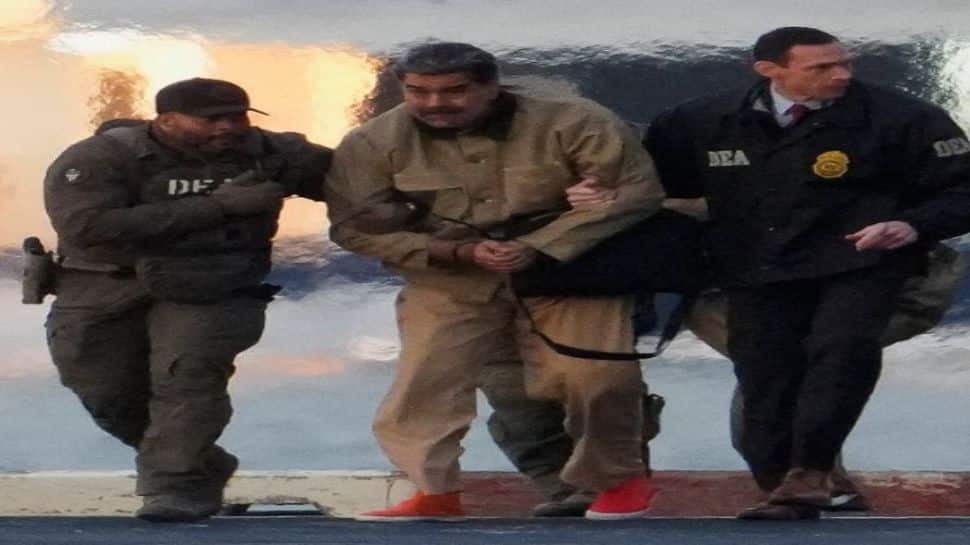
New Delhi: When the United States detained Venezuelan President Nicolás Maduro and his wife Cilia Flores in Caracas last Saturday (January 3), the global reaction split widely. Some countries condemned the US action in strong terms, while others offered support. India, however, did not join either camp, maintaining a neutral position consistent with its longstanding non-aligned foreign policy tradition.
Unlike Malaysia and South Africa, which publicly criticised the US intervention and expressed solidarity with Venezuela, New Delhi’s statement avoided taking sides. So, why did India, which positions itself as a leader of the Global South, not respond as forcefully?
Experts say India’s cautious stand is consistent with its historical approach, which avoids publicly siding with or against any single power during foreign interventions.
“South Asian government’s public reactions to US actions in Venezuela have been measured. This is not a tacit endorsement of them. It is a reflection, in a region w/many vulnerable economies, of pragmatism & the need for caution given considerations of US tariffs and sensitive trade talks,” Michael Kugelman, an analyst on South Asian politics, wrote on X.
He further added, “One can also argue that in a few cases, it’s a matter of following precedent. There have been various military invasions/interventions that India has privately opposed but not publicly condemned (the Russian invasion of Ukraine being the most prominent recent example).”
South Asian govt public reactions to US actions in Venezuela have been measured. This isn’t a tacit endorsement of them. It’s a reflection, in a region w/many vulnerable economies, of pragmatism & the need for caution given considerations of US tariffs and sensitive trade talks.
— Michael Kugelman (@MichaelKugelman) January 5, 2026
India’s Official Response
The day after the US action, Ministry of External Affairs (MEA) issued a statement expressing “deep concern” over recent events in Venezuela and emphasising close monitoring of the situation.
“The recent developments in Venezuela are a matter of deep concern. We are closely monitoring the evolving situation there,” the MEA said in a statement.
On Tuesday, in Luxembourg, External Affairs Minister S. Jaishankar reiterated the same. He urged all parties involved to prioritise the welfare and safety of the Venezuelan people. “We are concerned about the recent developments, and we appeal to all sides to arrive at a situation that serves the well-being and security of the people of Venezuela,” he said.
The focus, he emphasised, is on ensuring the safety of Venezuelan civilians and securing conditions for a stable outcome, rather than criticising or supporting any one party.
Why India Did Not Condemn America
Hapymon Jacob, founder of the Council for Strategic and Defense Research, explained India’s position in a series of posts on X. He described five reasons behind New Delhi’s measured response, pointing out that it also did not openly condemn Russia’s military action in Ukraine.
“There is a lot of noise about India’s silence on Caracas. India didn’t condemn Russia’s invasion of Ukraine, so it is unlikely to condemn the US in Venezuela. I think there is a belief in India that Great Powers operate in spheres of influence. What New Delhi hates is being pressurised to condemn one side while the other side does the same,” he wrote on the microblogging website.
“Is this a double standard?” he asked and replied, “If India had only condemned one side and not the other, it would appear so. Despite the ‘Trump shenanigans’, both Washington and Moscow remain vital partners for India’s national security and defense. When key partners make a move, even a massive legal mistake, you may not want to shout from the rooftops. You stay silent to keep your own channels open,” he said.
He continued, “India has a long history of avoiding foreign interference in its own policy and domestic matters. We value partners who engage with us privately. We do not rely on ‘megaphone diplomacy’.”
Jacob further added that Venezuela and Ukraine, while important internationally, are not as strategically critical to India as its immediate neighbourhood. Public condemnation of US actions could carry costs that outweigh any diplomatic gain.
“During Operation Sindoor, after receiving little practical support from the US, India understood Washington’s transactional approach. If we condemn the US now, it is likely that in the next crisis, it may side with our opponents. Whether Ukraine or Venezuela, neither is as strategically vital to India as its immediate neighborhood. So condemning US illegal actions could be far more costly than the potential benefit,” he concluded.
Why India isn’t joining the chorus of condemnation against the US attack on Venezuela.
There is a lot of noise about India’s silence on the Caracas strikes.
Here are the 5 reasons why I THINK official India may not condemn it.
PS: As an individual Indian, I condemn the…
— Happymon Jacob (@HappymonJacob) January 4, 2026
Regional Reactions And Comparisons
Malaysia’s Prime Minister Anwar Ibrahim openly criticised the US intervention on X, calling it a “clear violation of international law” and demanding the immediate release of President Maduro and his wife. He emphasised that Venezuelans must determine their political future without external interference.
“This kind of action is a clear violation of international law and is akin to the wrongful use of force against a sovereign nation. President Maduro and his wife should be released immediately. No matter the reason, forcibly removing a head of government by an outside power sets a dangerous precedent,” said.
“The people of Venezuela should decide their own political future. History shows that sudden power shifts through external forces do more harm than good,” he added.
I have followed developments in Venezuela with grave concern. The leader of Venezuela and his wife were seized in a United States military operation of unusual scope and nature. Such actions constitute a clear violation of international law and amount to an unlawful use of force… pic.twitter.com/9C1Fz1bppx— Anwar Ibrahim (@anwaribrahim) January 4, 2026
Former Indian Prime Minister Manmohan Singh’s media advisor Sanjay Baru quoted Ibrahim’s post and said, “Why did India not respond like Malaysia? Hats off to the Malaysian PM.”
South African President Cyril Ramaphosa, meanwhile, also denounced the US action in a video statement.
Sharing his video statement, a user commented, “South Africa is once again showing the leadership in the Global South that India once claimed.”
South Africa is once again showing the sort of leadership that India once claimed with the Global South. https://t.co/tZ5f3KClFh
— Sarayu Pani (@sarayupani) January 6, 2026
Many observers in India highlighted these responses, adding that they show a leadership role in the Global South that India has historically claimed.
Former Indian Foreign Secretary Kanwal Sibal weighed in, suggesting that as an emerging power with aspirations to lead the Global South, India could have been expected to issue a stronger statement.
“As an emerging power aspiring to leadership, claiming to speak for the Global South and advocating dialogue and diplomacy to resolve conflicts, one would have expected a statement from India on US interference in Venezuela,” he wrote, arguing, “We did not condemn Russia’s military intervention in Ukraine; instead, we called for dialogue and diplomacy, emphasizing that today is not the era for war.”
He explained, “Considering this approach and to maintain continuity, we do not need to use condemnatory language, but we can remind all sides to exercise restraint. We can emphasize the importance of respecting sovereignty, equality, and independence. We can stress avoiding unilateral actions, observing the UN Charter, and international law.”
“We can advise against actions that undermine the foundations of the international system, call for dialogue and diplomacy to resolve differences, and caution against double standards. We can also express concern for the particular vulnerabilities of developing countries in an increasingly uncertain world on security and economic matters,” he added.
India’s Non-Aligned Tradition
When Russia attacked Ukraine in February 2022, India also maintained a neutral position.
New Delhi has so far not openly condemned the attack, while repeatedly calling for peace and diplomatic solutions. India’s policy of not aligning with a single bloc is not new.
This non-aligned approach was laid by India’s first Prime Minister Jawaharlal Nehru and has been followed by successive governments.
In 1957, a year after Soviet intervention in Hungary, Nehru explained in Parliament why India did not condemn the USSR. “Many things happen every year, and every day, which we broadly disapprove of. But we did not condemn them because when someone is seeking a solution, condemnation does not help,” he said.
Historian Stanley Johny, editor of international affairs at The Hindu, says that India’s approach has been consistent for over decades. Whether it was the Soviet interventions in Hungary (1956) and Czechoslovakia (1968), Afghanistan (1979) or the American invasion of Iraq in 2003, India avoided public condemnation.
He explains that New Delhi’s historical neutrality guides its present policy, particularly when tensions involve its partners or major powers.
India’s measured response to the US invasion in Venezuela shows a combination of pragmatism, historical precedent and strategic calculation. By maintaining neutrality, India aims to preserve dialogue channels, protect its national interests and continue advocating for peaceful and diplomatic solutions, consistent with decades of non-aligned policy.
About the Author