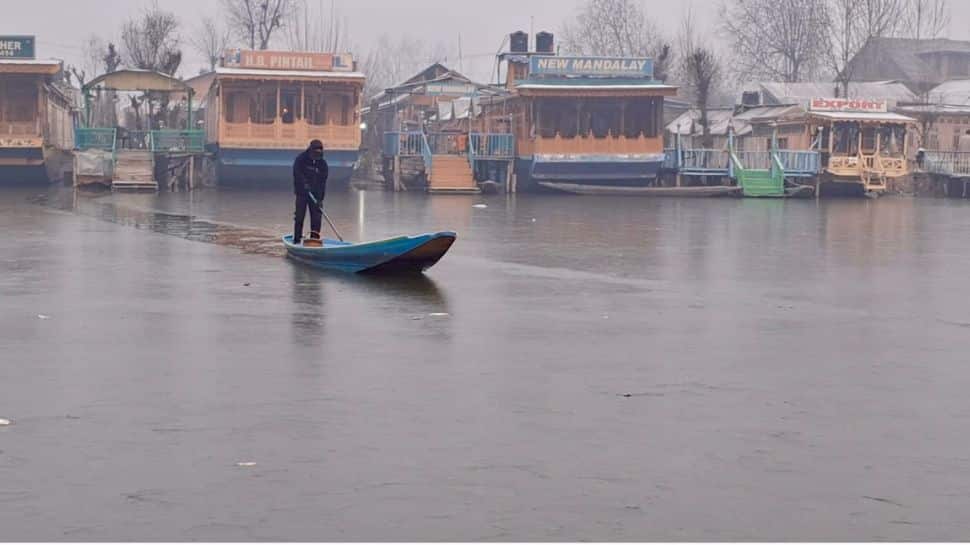
A severe cold wave has gripped Jammu and Kashmir and Ladakh, with temperatures plunging to record lows, freezing major water bodies, including the iconic Dal Lake. Drass in Ladakh remained the coldest inhabited place in the country at -24.6 degrees Celsius, while Srinagar recorded -6.0 degrees Celsius, its lowest of the season so far. The extreme cold, attributed to La Niña effects, has disrupted daily life, frozen water supply pipes, and drawn tourists to the partially frozen lakes.
Intense cold wave conditions in Kashmir and Ladakh are leading to the freezing of major water bodies and record-breaking low temperatures across both regions.
Drass in Ladakh remained the coldest inhabited place in the country, with temperatures plunging to a bone-chilling -24.6 degree celsius, while Srinagar, the summer capital of Kashmir, recorded a minimum of -6.0°C, its lowest temperature of the season so far. Srinagar’s airport witnessed an even sharper dip to -7.4 degrees Celsius.
No place in both regions witnessed temperatures above the freezing point. Shopian emerged as the coldest spot in the Kashmir Valley at -7.7 degrees Celsius, followed by Pahalgam at -7.6 degrees Celsius, Gulmarg at -7.2 degrees Celsius and Pulwama at -7.5 degrees Celsius. Other places recorded Qazigund at -6.2 degrees Celsius, Kupwara at -5.8 degrees Celsius, Awantipora at -6.0 degrees Celsius, Budgam at -5.9 degrees Celsius, Anantnag at -7.1 degrees Celsius, Baramulla at -5.7 degrees Celsius, Bandipora at -5.2 degrees Celsius, Sonamarg at -5.4 degrees Celsius, Rafiabad at -7.2 degrees Celsius and Sopore at -6.8 degrees Celsius.
Ladakh temperatures plunged further, with Leh settling at -14.4 degrees Celsius. Hanle recorded -16.2 degrees Celsius, Kargil -13.2 degrees Celsius, Nubra Valley -14.2 degrees Celsius, while Drass remained the coldest at -24.6 degrees Celsius. Padum recorded -20.3 degrees Celsius and Nyoma -21.6 degrees Celsius.
The impact of the cold wave can be seen on water bodies across Kashmir, which have partially frozen. Parts of the iconic Dal Lake, particularly its fringes, have frozen over, forming visible sheets of ice. The intense cold has also led to the freezing of other water bodies like Anchar Lake and Nigeen Lake, as well as water supply pipes and taps in both regions.
The region is currently amid the 40-day harshest winter period, known as Chillai Kalan, which began on December 21 and is set to end on January 30. The IMD has attributed the severe cold and dry conditions to the La Niña effect.
Tourists are flocking to the frozen Dal Lake to experience unique activities such as breaking ice during shikara rides on partially frozen waters, enjoying magical winter landscapes and the distinct sub-zero beauty. These frozen lakes offer a stark and beautiful contrast to their summer vibrancy, becoming major tourist attractions against stunning backdrops of snow-capped mountains.
However, both tourists and locals are worried about dangerous climate changes, as a lack of snowfall disrupts water supplies, dries up rivers and leads to agricultural crop failure, impacting livelihoods. Health risks such as respiratory infections are increasing, while locals face daily hardships from the cold. Boatmen struggle to row through frozen waters, and household taps freeze in the mornings.
The Meteorological Department has predicted a continuation of dry and cold conditions till January 22, after which a weak weather system may bring light to moderate snowfall over the Himalayas.
About the Author