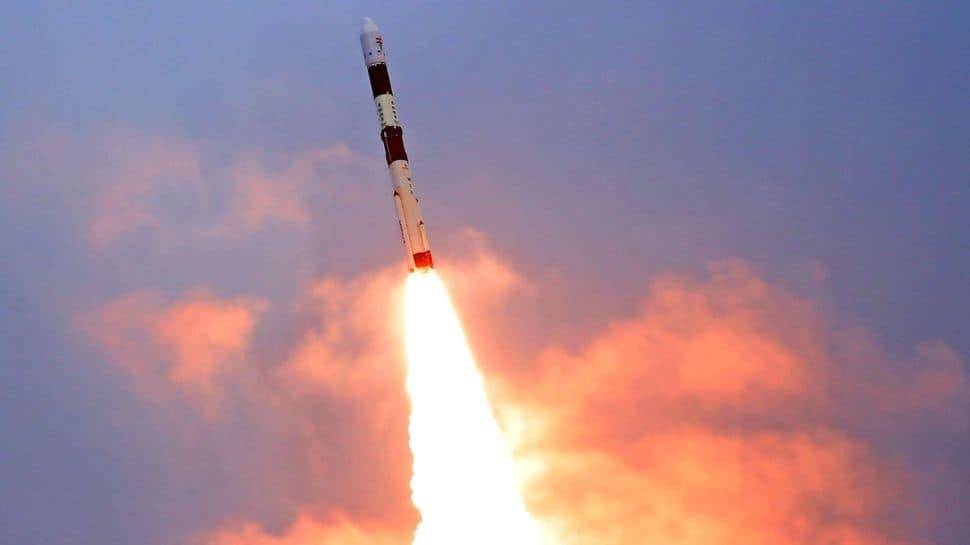
Picture this: You’re wearing regular sunglasses that show you the world in three colours. Now imagine switching to magical glasses that reveal hundreds of invisible colours, showing you things hidden from normal eyes. That’s exactly what India is sending into space this Monday morning at 10:17 am from Sriharikota, when our trusted workhorse rocket PSLV lifts off with a very special passenger – a satellite called Anvesha, which means ‘quest’ in Sanskrit.
Despite a rare setback last year, the PSLV remains India’s most dependable rocket, returning to the skies this Monday to reaffirm its legendary status. Standing 44 metres tall and weighing 260 tonnes, this rocket has successfully completed 63 missions – the same rocket that took Chandrayaan to the Moon, sent Mangalyaan to Mars, and created history in 2017 by launching 104 satellites in one go. This Monday’s flight, called PSLV-C62, will be its 64th journey, carrying not just Anvesha but also 15 smaller satellites from India, Brazil, UK, Thailand, Nepal, Spain and France – truly a global space gathering.
What makes Anvesha so special?
Built by our Defence Research and Development Organisation, this isn’t your regular camera-in-the-sky. It uses something called hyperspectral imaging. Think of your smartphone camera that captures three basic colours. Anvesha captures hundreds of different wavelengths of light, including ones completely invisible to human eyes like infrared heat signatures. Every material on Earth – whether it’s soil, water, concrete, vegetation or military equipment – reflects light differently across these hundreds of wavelengths. It’s like each material has its own unique fingerprint made of light.
This gives Anvesha almost superhuman vision. Imagine someone wearing camouflage in a forest. Your eyes might miss them completely, but Anvesha’s sensors can tell the difference between real leaves and fabric painted to look like leaves. It can spot healthy crops versus diseased ones, clean water versus polluted water, natural grass versus artificial turf, and most importantly for national security, it can distinguish military equipment from civilian vehicles even when they’re deliberately hidden.
For a country like India with long, difficult borders, this is a game-changer. Our troops stationed in harsh terrains of Ladakh or Kashmir will have Anvesha’s watchful eye providing round-the-clock surveillance without risking lives. If an adversary builds a new road, bridge or bunker near the border overnight, Anvesha will catch it. During tensions, this early warning system gives our defence planners crucial time to respond appropriately. It can even track illegal smuggling routes or unauthorised border crossings.
But Anvesha isn’t just a military asset. Farmers can use its data to check crop health even before problems become visible to the naked eye. Urban planners can map cities better. Environmental scientists can monitor forests, water bodies and mineral resources. Disaster management teams can assess damage after floods or earthquakes. This one satellite serves both national security and civilian progress.
The mission itself is fascinating. After lifting off, the rocket will climb to a maximum height of about 511 kilometres above Earth. Eighteen minutes into the flight, when the spacecraft is hurtling through space at 27,400 kilometres per hour, Anvesha will separate first. Then, one by one, the other satellites will deploy. The last passenger is quite unusual – a small Spanish capsule called KID that will test re-entry technology before splashing down in the South Pacific Ocean. The entire mission will take 108 minutes from launch to the final separation.
Among the Indian satellites riding along is AyulSat from OrbitAid, which will test refuelling satellites in space – technology that could extend satellite lifespans dramatically. Another is MOI-1 from Dhruva Space, allowing advanced artificial intelligence programs to run directly on satellites instead of on Earth. The LACHIT and Thybolt-3 satellites will test how groups of satellites can work together to serve multiple users simultaneously.
For those watching from their homes this Monday morning, what’s lifting off from Sriharikota is more than just a rocket. It’s India’s technological prowess on full display, it’s our commitment to national security without compromising civilian benefits, and it’s our growing reputation as a reliable space partner for nations across the world. From the Moon to Mars, from Earth observation to navigation, India’s space story just keeps getting bigger. And this Monday, with Anvesha opening its superhuman eyes from space, we’re writing another exciting chapter in that story.
(Girish Linganna is an award-winning science communicator and a Defence, Aerospace & Geopolitical Analyst. He is the Managing Director of ADD Engineering Components India Pvt. Ltd., a subsidiary of ADD Engineering GmbH, Germany)
About the Author