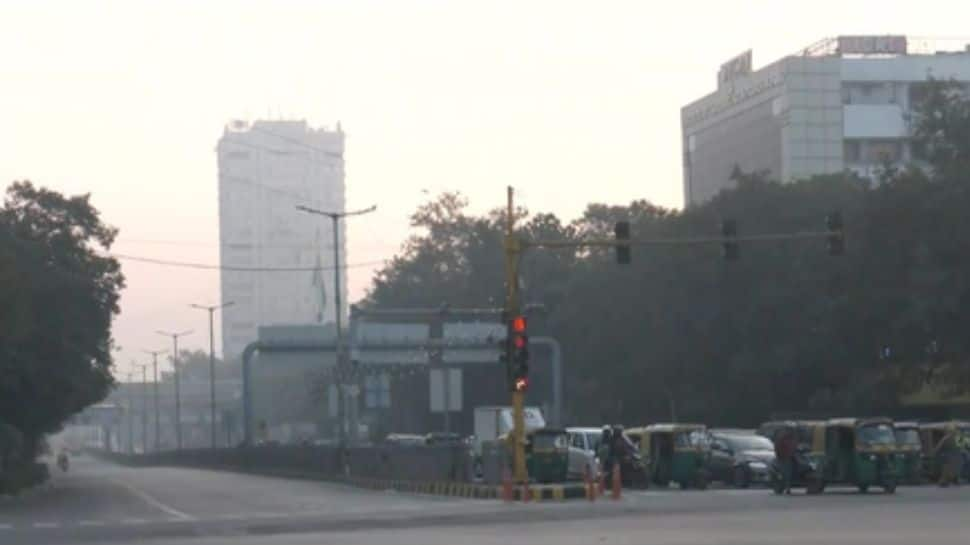
New Delhi: Delhi and the NCR woke up on Monday to another day covered in thick smog, with the air quality still stuck in the “very poor” range. The heavy haze has been hanging over the region for weeks, making the air difficult to breathe and forcing people to take extra care while stepping outside.
The overall Air Quality Index (AQI) touched 318, which is slightly higher than what was recorded on Sunday. This small increase shows that the air is still very polluted and conditions have not improved.
The city on Sunday witnessed slightly clearer skies and a minor improvement in air quality, offering residents brief relief from persistent smog. The real-time AQI stood at 277, a slight improvement from the previous day. Despite this, pollution levels remained significantly high. PM10 concentrations were measured at 263 µg/m³, while PM2.5 levels stood at 199 µg/m³.
Air Quality Levels In Different Areas
- Bawana recorded the highest pollution in Delhi with an AQI of 368 on Monday.
- Anand Vihar and Pusa also reported very polluted air, with levels above 350.
- In the NCR, Noida and Ghaziabad showed AQI readings of 333 and 325, placing them in the ‘poor’ category.
- Air quality was slightly better in Gurugram and Faridabad, where the AQI stood at 282 (poor) and 200 (moderate).
According to the Decision Support System for Air Quality Management, vehicular emissions continued to be the biggest contributor to Delhi’s pollution burden, accounting for nearly 16.5 per cent. Industrial units in and around the national capital contributed 8.1 per cent, while construction activities added 2.3 per cent. Household emissions, including heaters, generators and stoves, made up approximately 4 per cent.
Over the past week, Delhi’s air quality has fluctuated between ‘poor’ and ‘very poor’ levels. AQI values recorded include 279 on November 30, followed by 304, 372, 342, 304, 327, and 330 over the next six days, respectively.
In response, municipal authorities have stepped up mitigation measures, including regular water sprinkling along pollution-prone stretches such as the Mehrauli-Badarpur Road.
Residents are growing increasingly worried as the air quality continues to worsen. Speaking to IANS, a local resident said, “The government needs to prioritise this issue, but citizens must also take responsibility. Much of the pollution is generated by our everyday activities — from vehicles to equipment we use.” The concern reflects how both authorities and the public need to work together to reduce pollution levels.
(From the Inputs of IANS)
About the Author