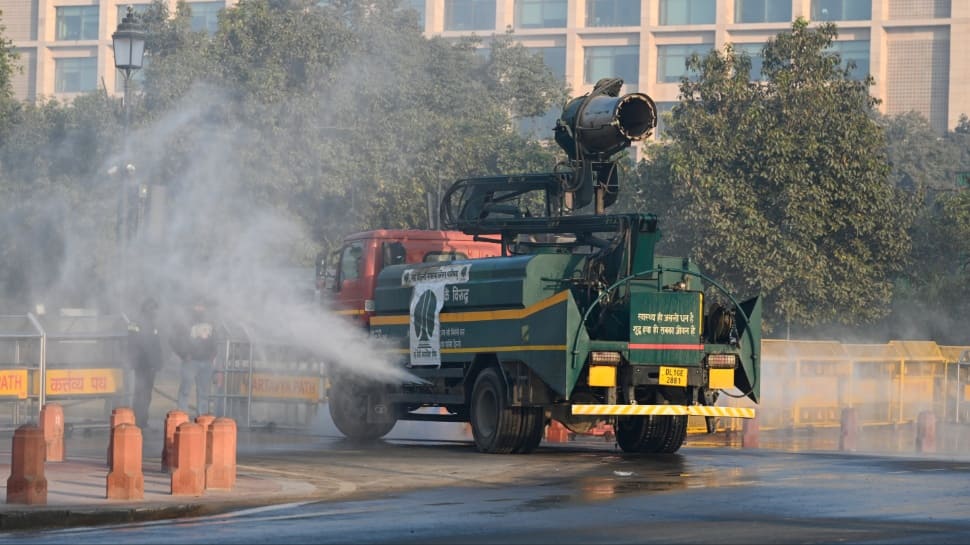
This year, the pollution crisis in the Delhi-NCR region has stretched from October to December, maintaining consistently severe to critical AQI levels even with minimal contribution from the crop residue burning. A new report by the Centre for Science and Environment, ‘Toxic Cocktail of Pollution During Early Winter in Delhi-NCR’, identifies local emission sources as the prime culprits and warns of five new dangers that are now expanding and aggravating.
The pollution this year, the report said, is a deadly combination of high PM2.5 combined with high NO2 and CO. Experts at the CSE say that minor measures can no longer help; strong, systemic changes are needed to cut emissions from vehicles, industries, and power plants.
The report has analyzed trends from October and November-up till November 15-based on CPCB data, and details five new threats:
1. Longer And Uncontrolled Pollution Season
This year, the pollution episode has lasted for over 80 days, extending from October well into December, whereas it used to subside by November. In fact, the AQI has stayed in the ‘Very Poor’ to ‘Severe’ category for almost the entire month of November.
Scientific Fact: Compared to the previous year, PM2.5 averaged 9% less but equaled the three-year average, remaining steady at around 100 micrograms per cubic meter (µg/m³).
Reason: During winter, the atmospheric boundary layer turns shallow and traps pollutants. Vehicular emissions increase manifold during peak traffic time-7-10 Am and 6-9 PM-and the PM2.5 increase is pretty rapid. According to the CSE expert Anumita Roychowdhury, this trend reflects a reduced dependence on meteorology, with greater priority given to source control at the local level.
2. Explosion Of Pollution Hotspots And Regional Spread
Hotspots of pollution have increased manifold since 2018, where a number of places recorded alarming levels of contamination.
Worst Affected: Jamesgirpurpuri recorded an annual pm2.5 average of 119 μg/m3, followed by bawana and wazirpur at 113 ag/m3
New Hotspots: Other emerging areas include Vivek Vihar with 101 µg/m³, Nehru Nagar, Alipur, Siri Fort, Dwarka Sector-8, and Patparganj, crossing the 90 µg/m³ mark.
Reason: These hotspots, now identified as permanent, are driven by dense traffic, industries, construction activity, and waste burning in North and East Delhi.
3. Local Sources Emerge As Primary Villain: Contribution of 85%
Due to heavy rains in Punjab and Haryana, the incidents of stubble burning were considerably fewer this year, contributing less than 5% on most days in October-November, and peaking at only 22% on November 12-13.
Scientific Fact: Even with minimal stubble burning, the air remained toxic. PM2.5 affected AQI for 34 days, PM10 for 25 days, and Ozone for 13 days.
Reason: This points overwhelmingly to local sources: vehicles (contributing NO2 and CO), industries, power plants, waste burning, and domestic fuels. CSE draws the conclusion from this that although reduced stubble burning prevented severe peak spikes, the dangerous average pollution levels remained stable.
4. The Silent Threat: Toxic Cocktail of NO2 and CO
While headlines might be dominated by PM2.5, the concurrent rise in NO2 and CO levels creates a toxic cocktail often overlooked.
Science Fact: NO2 and PM2.5 increase together at morning and evening peaks because of traffic. CO exceeded the 8-hour standard of 2 mg/m³ on more than 30 days at 22 monitoring stations, with a maximum of 55 days in Dwarka Sector-8.
Health hazard: This combination is especially hazardous because it deteriorates the lungs, blood, and heart, making the air much more toxic to breathe.
5. Smog Intensity Now More Severe in Smaller NCR Cities
Smaller surrounding cities like Bahadurgarh, Panipat, and Rohtak have registered pollution levels as high as-or even higher than-Delhi as the entire NCR is now acting as one single airshed.
Regional Spread: Bahadurgarh reported dense smog for 10 days during November 9-18. The long-term trend indicates that the PM2.5 is stabilizing, and the annual average in 2024 was 104.7 µg/m³, hence indicating there has been no overall improvement.
Solutions: Leapfrog Strategy Needed
CSE therefore strongly argues for a “leapfrog strategy” rather than incremental changes, as the pollution levels have reached an unsafe plateau.
Short-term measures: “Strict implementation of rules under GRAP, mainly on vehicles and dust control, and increased monitoring of CO and NO2.
Long-term systemic changes:
Vehicles: Time-bound transition of all vehicles to electric, comprehensive scrapping of old vehicles, and promotion of public transport, cycling, and walking; introduction of parking caps and congestion tax.
Industry: Require rapid and least-cost switching to cleaner fuels, electrification of processes, and more stringent controls.
Waste Management: A stop to the burning altogether, better segregation, landfill remediation, and increased recycling.
Agriculture: Emphasis on in-situ management of the stubble (mixing into soil) or ex-situ solutions, such as bio-methanation for producing ethanol and gas, which can also enhance farmer income.
ALSO READ | Hyderabad Cold Wave Alert: IMD Warns Of 12 Degrees Celsius Plunge; Telangana Districts Could Hit 5 degrees Celsius
About the Author