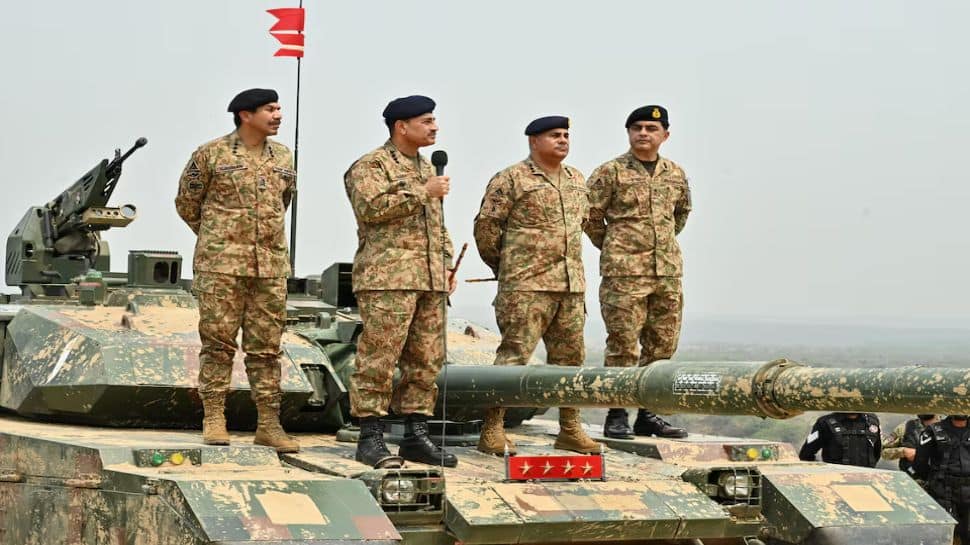
Pakistan Military Leadership Vaccum: Pakistan’s political and military landscape is facing an unprecedented period of uncertainty following the expiration of the deadline to appoint the country’s first chief of defence forces (CDF). The ambiguity surrounding Field Marshal Asim Munir’s position has triggered concerns among analysts, with fears that his actions could destabilise regional security.
Speaking to ANI, Tilak Devasher, former member of Pakistan’s National Security Advisory Board (NSAB), warned that Munir could provoke an incident to assert his influence, despite the confusion over his official status. He highlighted the risks of a leadership vacuum compounded by the Army chief’s history of anti-India rhetoric.
“Just to prove his utility, he (Asim Munir) could provoke an incident. Even though technically he may not be the Army chief, he could still provoke it. Who is to challenge him? So, it is a very unsatisfactory and even a very serious situation for Pakistan. Because even the Army is not sure whether he is the chief or not, and in case it gets into his mind to provoke an incident with India, what happens then? So, it is a dangerous situation,” he said.
Devasher attributed the delay in formalising the appointment to the weakness of Pakistan’s civilian government, which was pressured by the military to create the post of the CDF.
“The fact is that the civilian leadership is extremely weak to oppose Munir and the military. So, they are doing these tricks by the back door. If they were strong, they could have told him that they were not going to give him five years or make him the CDF. But this was rammed through Parliament under pressure from the Army to create the post of the CDF, which is also the head of the Army, the Air Force and the Navy. So, it is because of the weakness of the civilian government. That is the reason why they are delaying it through backdoor tactics rather than being upfront. He has already done three years, so by the time he finishes, he will have done eight years. He could then seek five years after that. People suspect that if he gets five years now till 2030, he will carry on till 2035,” he explained.
Meanwhile, Pakistan’s Defence Minister Khawaja Asif told the press on Sunday that the notification regarding the CDF appointment would be issued “in due course of time”, informing that the process had already begun, according to Dawn.
Created under the 27th Constitutional Amendment, the CDF post replaces the abolished office of the Chairman Joint Chiefs of Staff Committee (CJCSC), which officially ended on November 27. The new role combines responsibilities as both the Army chief and the CDF, a dual-hatted position meant to streamline command.
Observers had expected the official notification to coincide with the CJCSC’s abolition. However, the key November 29 deadline passed without any formal appointment, marking the expiration of Munir’s original three-year tenure as the Army chief.
Asif’s statement suggests the appointment may now await the return of Prime Minister Shehbaz Sharif from London. Information Minister Attaullah Tarar confirmed to Dawn that the PM is expected back in Pakistan on Monday.
The current ambiguity has left Pakistan’s military and civilian leadership in a delicate position, raising alarms about potential risks not only within the country but across the region.
About the Author