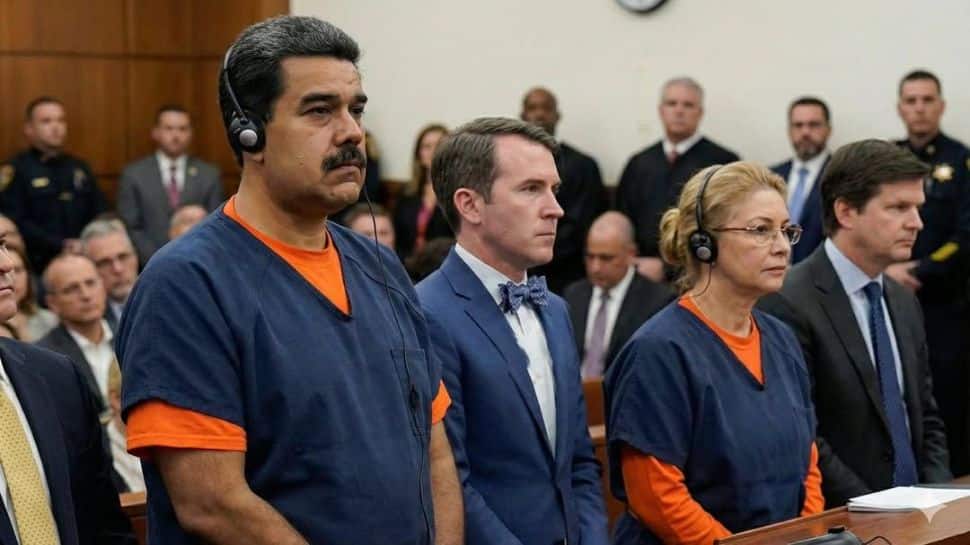
New Delhi: Two days after former Venezuelan President Nicolás Maduro, 63, was captured by US special forces in a secret operation in Caracas, he was brought before a federal court in New York. His appearance set off a major legal battle and raised geopolitical tensions.
On Monday (January 5), Maduro entered a plea of not guilty to a sweeping list of federal charges, including narcoterrorism and conspiracy to import cocaine into the United States. Wearing a blue-and-orange prison uniform, he stood silently as prosecutors read the charges against him. The case also names his wife, Cilia Flores, and his son as co-defendants.
The US administration headed by President Donald Trump has presented the Venezuelan leader’s capture as a law enforcement action, maintaining that no approval of the Congress was required.
Inside the courtroom, Maduro offered a different account, insisting that he was not a criminal suspect but a “prisoner of war (POW)” held by an enemy power.
What Maduro Told The Court
Speaking through an interpreter, he addressed the judge directly before being interrupted by US District Judge Alvin Hellerstein in Manhattan federal court.
“I am innocent. I am not guilty. I am a decent man. I am still president of my country. I am prisoner of war,” Maduro said.
By calling himself a prisoner of war, he claimed a status under international law that applies to people captured by an enemy during a war.
His wife, Cilia Flores, who also appeared in court as a co-defendant, entered her own plea of not guilty on Monday.
Venezuelan Leadership Closes Ranks
Maduro’s claim echoed back home. On Saturday, Interim President Delcy Rodríguez appeared on state television along with her brother Jorge Rodríguez, the president of Venezuela’s National Assembly, Interior Minister Diosdado Cabello and Defence Minister Vladimir Padrino López. Together, they declared that Maduro was Venezuela’s only legitimate president.
On Monday, the same day Rodríguez assumed the role of interim president, her public tone changed. In a message posted on social media, she signalled openness to engagement with Washington and extended an invitation to President Donald Trump.
“President Donald Trump, our people and our region deserve peace and dialogue, not war,” she wrote, calling for “respectful relations” and cooperation.
Venezuela’s Ambassador to the United Nations Samuel Moncada framed the crisis in broader terms. “We cannot ignore a central element of this US aggression. Venezuela is the victim of these attacks because of its natural resources,” he said, according to the UN website.
Washington’s Official Line
US officials have consistently described the January 3 operation in Caracas, which led to Maduro’s capture, as a law enforcement mission rather than a military act.
Secretary of State Marco Rubio told NBC’s Meet the Press on Monday that the United States was not at war with Venezuela. “We are at war against drug trafficking organisations. That is not a war against Venezuela,” he said.
At the United Nations, US Ambassador Michael Waltz reiterated the same, arguing that the operation targeted transnational crime networks posing threats to United States and regional security.
“There is no war against Venezuela or its people. We are not occupying a country. This was a law-enforcement operation in furtherance of lawful indictments that have existed for decades,” he said, according to the UN website.
President Trump’s own statements have painted a far more expansive picture of US intentions. Speaking at a news conference on Saturday, he said the United States would “run” Venezuela until a “safe, proper and judicious transition” could take place.
On Sunday, he warned that Washington was prepared to launch a second military strike if Venezuelan authorities refused to cooperate with his plan to “resolve” the situation.
A Different Reality
The statements have drawn criticism from legal experts. Rubio is not the president. Trump has declared unequivocally that the United States is engaged in armed conflict with Venezuela to justify more than 100 killings of alleged drug traffickers in the Caribbean and eastern Pacific.
Beginning in September, the US military carried out a series of strikes on boats in the Caribbean Sea and eastern Pacific, claiming the vessels were transporting narcotics. At least 100 people have died in more than 30 such attacks.
The Trump administration has not released public evidence to prove that drugs were on board, that the boats were bound for the United States or that those killed belonged to banned organisations.
If the United States were not at war, Trump would be confessing to mass murder of civilians.
Why The ‘POW’ Label Matters
Maduro’s insistence on being recognised as a prisoner of war carries legal implications. If that status applies, he would fall under the protections of the Third Geneva Convention of 1949, which requires humane treatment and safeguards for POWs.
The convention allows detained prisoners of war to be tried by the detaining power, though typically for offences such as war crimes. Maduro faces narcotics-related charges, not allegations of war crimes. The same convention also states that prisoners of war must be returned to their country “without delay” once hostilities end.
According to Trump, Maduro is a prisoner of war because the US president declared that the Venezuelan leader initiated war against the United States via drug trafficking leading to overdose deaths. That would mean the Geneva Conventions apply, but Trump is likely to disregard it.
Questions Of Sovereignty And Oil
Experts say the US explanation does not hold up when closely examined. The operation could not credibly be framed as a domestic policing matter.
“They sell the operation as a domestically motivated drugs issue, but it is clearly not. They violated national sovereignty. Even though Maduro is a dictator, there is no legal argument to hijack him and his wife through a US military operation,” said the experts.
They described the capture as a breach of Article 2 of the UN Charter, which affirms the sovereign equality of states. “Regime change or access to oil do not justify unilateral military interventions,” they said.
They linked US actions directly to Venezuela’s vast energy reserves. “This is less about Maduro and more about access to Venezuela’s oil deposits,” they alleged.
Venezuela holds the world’s largest proven oil reserves, estimated at 303 billion barrels in 2023. Despite that, its oil revenues have collapsed. Data from the Observatory of Economic Complexity shows Caracas exported only $4.05 billion worth of crude in 2023, far behind Saudi Arabia, the United States and Russia, largely due to US sanctions.
“This oil is the number one target. Trump is not content with allowing US oil firms to secure concessions. He wants to ‘run’ the country, which means absolute and indefinite control over Venezuela’s resources,” said the experts.
For critics, the months-long US military campaign against Venezuelan targets, including the bombing of boats, makes it impossible to view Maduro’s capture as a routine arrest.
“Trump’s seizure of Venezuelan oil and displacement of Venezuelan sovereignty are acts of war,” they concluded.
About the Author