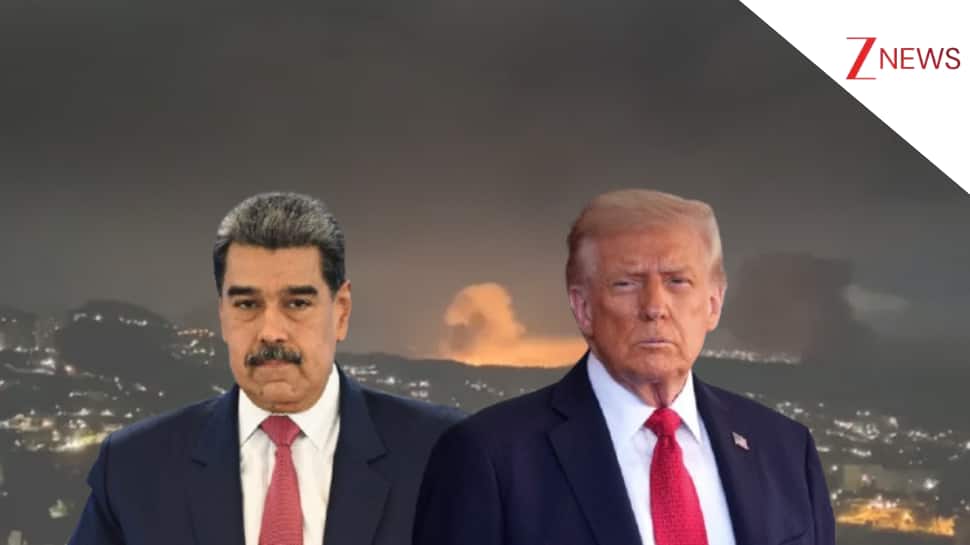
The United States’ military intervention in Venezuela on the night of January 3, 2026, has plunged the Western Hemisphere into fresh uncertainty. While the air strikes and the arrest of President Nicolás Maduro and his wife were unprecedented, the confrontation itself was not entirely unexpected. Tensions between Washington and Caracas had been steadily building, and recent US policy statements had already signalled a tougher line.
The November 2025 National Security Strategy (NSS) released by President Donald Trump made it clear that the Monroe Doctrine was back at the centre of American foreign policy. The document spoke of restoring an undisputed US “sphere of influence” in the Western Hemisphere and outlined plans to create an inter-agency task force, backed by the Intelligence Community, to “identify strategic points and resources in the Western Hemisphere with a view to their protection and joint development with regional partners”. It also emphasised keeping “non-hemispheric competitors” out of the region so they could not “harm [the US] strategically in the future”.
Against this backdrop, along with long-running disputes over alleged narcotics trafficking and US sanctions on Venezuelan oil traders, the January 3 intervention appeared less sudden and more like the culmination of an unfolding strategy.
China In Washington’s Crosshairs
China clearly fits the NSS description of a “non-hemispheric competitor”. The Maduro government maintained close political, economic and military ties with Beijing, making China a major stakeholder in Venezuela. With Maduro now expected to face “the full wrath of American justice on American soil”, as US Attorney General Pam Bondi put it, China’s interests in Venezuela, and in Latin America more broadly, are under serious threat.
Beijing’s immediate response was sharp. The Chinese foreign ministry condemned the US strikes as a violation of Venezuela’s sovereignty, international law and the principles of the UN Charter, warning that they “threaten peace and security” in Latin America. As in other crises, China leaned heavily on the language of international law, even as it framed the US action as an example of raw power overriding global norms.
Beyond diplomatic rhetoric, however, two deeper concerns stand out for Beijing — the apparent failure of Chinese military equipment used by Venezuelan forces, and the future of China’s vast oil and financial investments in the country.
Questions Over Chinese Weapons
Venezuela’s armed forces were equipped with a range of Chinese-made systems. The National Guard operated more than 100 VN4 armoured utility vehicles, while the Marines deployed VN-1 and VN-18 infantry fighting vehicles. The Air Force flew more than 20 K-8 “Karakorum” light attack aircraft, jointly developed by China’s Hongdu Aviation Industry Corporation. Most notably, Venezuela fielded the JY-27 counter-stealth radar produced by the China Electronics Technology Group Corporation (CETC), which Chinese officials claimed in May 2025 could detect “extremely stealthy targets”.
Yet during the US operation, which reportedly involved F-22 and F-35 stealth aircraft, Venezuela’s air defences failed to detect or counter incoming strikes. This suggests that the radar systems, along with the armoured vehicles and other platforms, were either neutralised early, overwhelmed, or poorly deployed.
The reaction within China has been telling. After Pakistan’s air-defence operations against India during Operation Sindoor, Chinese commentators openly praised Islamabad’s “Made in China” military hardware. Following events in Caracas, however, there has been little public discussion about the performance of Chinese weapons.
Instead, Chinese analysts have focused on how the US operation succeeded. Commentaries have highlighted early air strikes and possible electronic warfare that disabled Venezuela’s air force, enabling helicopters carrying Delta Force units to reach Maduro’s residence. Others have pointed to the role of the CIA in gathering intelligence, with some suggesting that US agencies may have “bought over” Venezuelan military commanders. On social media, a few voices have attributed the success to the “money-burning” nature and “unlimited budget” of elite US forces.
The silence on Chinese equipment itself may reflect unease in Beijing about how its export-grade systems fare against America’s most advanced military capabilities, and the potential impact this could have on China’s global arms exports.
China’s Oil Gamble At Risk
More serious still are the economic stakes. China is Venezuela’s largest single-country oil buyer, accounting for an estimated 55-90 per cent of its oil exports in 2025. Since 2007, the China Development Bank has invested roughly $50-60 billion in Venezuela through “loans-for-oil” agreements.
For Chinese policymakers, the US intervention threatens more than two decades of strategic investment. Tens of billions of dollars in outstanding loans and long-term energy arrangements are now at risk. Many of these contracts were signed at fixed prices, leaving China with few quick or affordable alternatives.
Unlike in countries such as Sri Lanka or Pakistan, where China holds physical assets like ports or infrastructure as collateral, its Venezuelan investments are tied to oil resources that are now under effective US control. This raises the prospect of a complete write-off, potentially the largest single loss linked to President Xi Jinping’s Belt and Road Initiative.
Just a day before the intervention, on January 2, China’s Special Representative for Latin American Affairs, Qiu Xiaoqi, was reportedly in Venezuela to discuss expanding economic cooperation and coordinating against what Beijing calls US “unilateral coercion”. The visit underscored how seriously China views its ties with Latin America, ties that Washington increasingly sees as a strategic challenge.
A signal To Beijing
The January 3 operation, combined with the rare US sanctions imposed earlier on Hong Kong and mainland-based oil traders dealing with Caracas, sends a clear message — the US is prepared to use force to enforce its dominance in the Western Hemisphere.
For China, the episode sets an uncomfortable precedent. It may prompt Beijing to reassess both its Latin America strategy and its ability to project power far from home. At the same time, it offers China fresh material to appeal to the “Global South” by portraying the US as an unchecked hegemon.
Whether Beijing interprets American impunity as a reason to escalate tensions closer to its own borders remains uncertain. What is clear is that China will study the events surrounding January 3 closely, not only to understand US military and intelligence capabilities, but also to reassess its own strategic and economic vulnerabilities in the face of American power.
About the Author