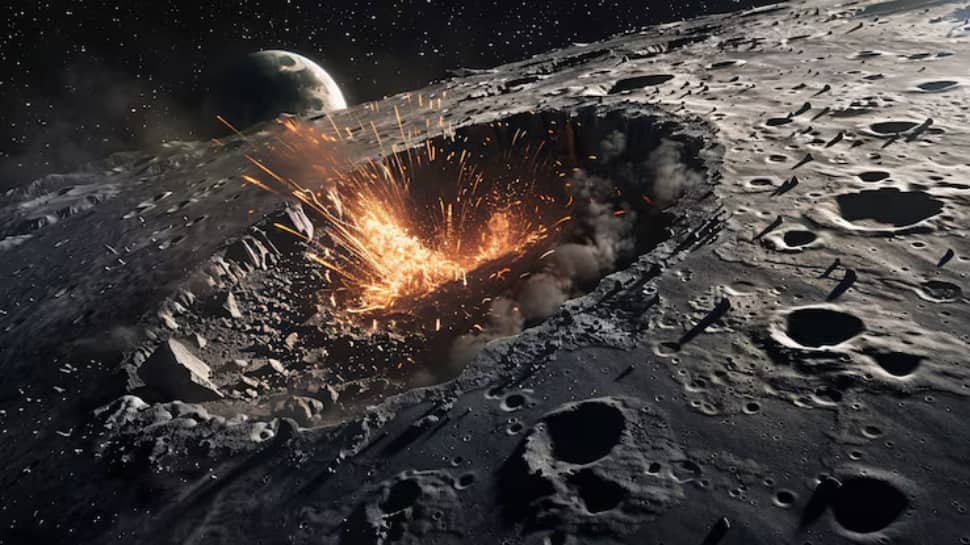
What would really happen if an asteroid slammed into the Moon? Would it crack apart, shower Earth with debris, or quietly leave a scar on its surface? These questions are resurfacing after NASA scientists identified a near-Earth object that may come dangerously close to the Moon in 2032, an encounter that could have lasting implications for lunar science and exploration.
NASA analysts are tracking asteroid 2024 YR4, a space rock that has drawn attention due to its unusual shape and orbital behaviour. While experts stress there is no threat of catastrophe, the potential interaction has opened new conversations about how prepared we are for impacts beyond Earth.
The Discovery Of Asteroid 2024 YR4
Asteroid 2024 YR4 was first detected by NASA’s Planetary Defense Coordination Office during routine monitoring of near-Earth objects. What makes it stand out is its irregular structure and the way its orbit brings it unusually close to the Moon’s path.
Although the asteroid is not massive enough to cause large-scale destruction, scientists are carefully studying its composition and movement. Understanding how such objects behave is crucial, not just for Earth’s safety, but also for protecting future missions beyond our planet.
Could It Really Hit The Moon?
According to current models, a direct impact with the Moon in 2032 remains a low-probability scenario, but it is not impossible. If a collision were to occur, the Moon would not be destroyed. Instead, scientists expect the formation of a new crater, accompanied by debris being launched into space.
Such an event would offer a rare scientific opportunity. Lunar impacts allow researchers to study the Moon’s internal structure and surface composition in ways that are otherwise difficult to achieve.
Craters, Debris, And Scientific Clues
The size of any crater formed by asteroid 2024 YR4 would depend on its speed, angle, and material makeup at impact. While the visual effect could be dramatic, the real value lies in the data. Ejected debris could reveal layers of lunar material that have remained hidden for billions of years.
For scientists, this would be a natural experiment, one that deepens our understanding of how the Moon has evolved.
What This Means For Future Lunar Missions
With renewed global interest in returning humans to the Moon, potential asteroid impacts are no longer just theoretical concerns. Research into 2024 YR4 is already helping scientists think about shielding lunar equipment, protecting astronauts, and planning safer landing zones.
Even minor impacts can pose risks to long-term habitation and infrastructure, making continuous monitoring essential.
Why Planetary Defense Matters More Than Ever
The case of asteroid 2024 YR4 highlights the growing importance of planetary defense, not just for Earth, but for the entire Earth-Moon system. NASA’s tracking programs allow scientists to anticipate risks early and refine response strategies well in advance.
The Bigger Picture
While experts agree that asteroid 2024 YR4 is unlikely to cause widespread damage, its possible 2032 lunar encounter serves as a powerful reminder: space is dynamic, unpredictable, and constantly evolving. Each such event strengthens our understanding of asteroid behaviour, improves planetary defense, and shapes the future of lunar exploration.
The Moon isn’t saying goodbye, but it may gain a new scar that helps humanity learn how to better protect its place in space.
(This article is intended for your general information only. Zee News does not vouch for its accuracy or reliability.)
About the Author