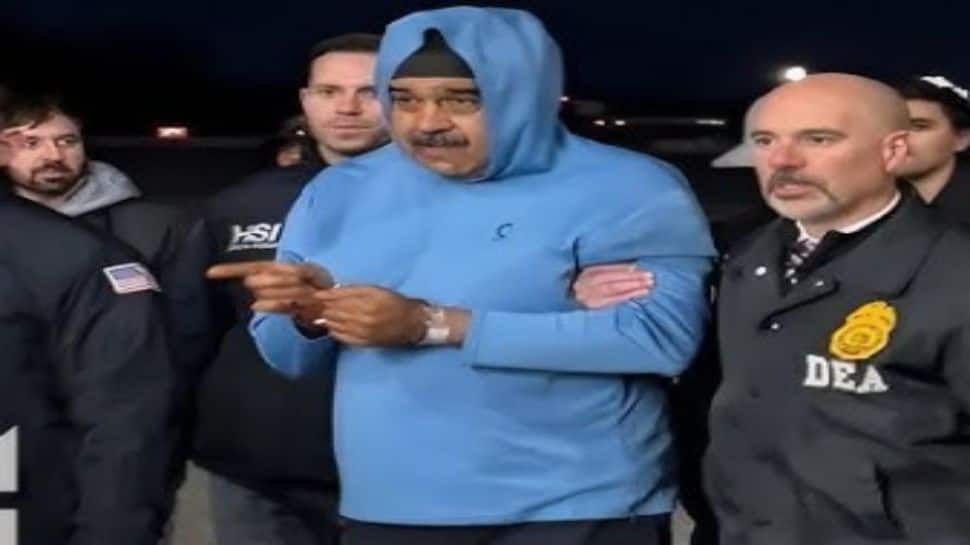
New York: Wearing a blue jail uniform, Venezuelan President Nicolas Maduro walked into a Manhattan courtroom on Monday (January 5). He rejected the charges that brought him there, declaring himself the “president of my country” and describing his capture as an “abduction”.
“I was captured,” Maduro said in Spanish, according to a courtroom translation, before the judge interrupted him. When asked to enter his plea, he said once again, “I am innocent. I am not guilty. I am a decent man, the president of my country.”
The hearing was Maduro’s first public appearance since he and his wife were taken into custody from their home during a late-night US military operation that Washington says justified his removal from power. The case now being heard in federal court is the most important prosecution of a foreign head of state undertaken by the US government in decades.
The criminal proceedings are taking place along with a US-backed effort to change regime in Caracas. President Trump has said the move would allow his administration to “run” Venezuela.
Maduro entered the courtroom shortly before noon along with his wife, who is also a co-defendant. Both wore headsets to follow the English-language proceedings as they were translated into Spanish. The appearance was brief and procedural. His next court date has been scheduled for March 17.
Earlier that morning, the couple had been transported under armed guard from a Brooklyn detention facility, where they have been held since arriving in the United States on Saturday.
The transfer was swift and tightly controlled. A motorcade carrying Maduro left the jail around 7:15 a.m. and drove to a nearby athletic field. From there, the Venezuelan president walked slowly to a waiting helicopter. The aircraft crossed New York Harbor and landed at a Manhattan heliport, where he, who was visibly limping, was placed into an armoured vehicle.
Within minutes, the convoy entered a secure garage at the federal courthouse complex. The location is around the corner from the courthouse where Trump was convicted in 2024 on charges of falsifying business records.
Outside, the police kept a small but growing group of protesters separated from a handful of pro-intervention demonstrators. At one point, a man pulled a Venezuelan flag away from protesters opposing the US action.
As a defendant in the American legal system, Maduro is entitled to the same rights as any person charged with a crime, including the right to a jury trial composed of New York residents. His case is unusual given his former position and the circumstances of his arrest.
Maduro’s legal team is expected to challenge the legality of his capture, arguing that he is immune from prosecution as a sitting head of state. A similar argument was made unsuccessfully by Panamanian leader Manuel Noriega after the United States captured him during a military invasion in 1990. The US government does not recognise Maduro as Venezuela’s legitimate president, particularly following his disputed re-election in 2024.
Venezuela’s Interim President Delcy Rodriguez has demanded return of Maduro, who has long denied any involvement in drug trafficking. On Sunday night, she also struck a more conciliatory tone on social media, calling for cooperation with the Trump administration and “respectful relations” with the United States.
Before his capture, Maduro and his allies had said that US hostility toward his government stemmed from interest in Venezuela’s vast oil and mineral wealth. The US military operation took place early Saturday, when American forces entered a military base and detained Maduro and his wife at their residence.
Trump said the United States would temporarily “run” Venezuela. Secretary of State Marco Rubio said on Sunday (January 4) that Washington would not manage the country’s day-to-day affairs beyond enforcing an existing “oil quarantine”.
Trump has since signalled interest in expanding American influence across the Western Hemisphere. Speaking aboard Air Force One, he described Colombian President Gustavo Petro as “a sick man who likes making cocaine and selling it to the United States. And he is not going to be doing it very long”.
Trump also warned Delcy Rodriguez to grant “total access” to Venezuela or face consequences. He has suggested that Maduro’s removal would allow more Venezuelan oil to reach global markets.
Oil prices nonetheless rose slightly on Monday (January 5) morning, climbing more than 1 percent to about $58 a barrel. Analysts have pointed to uncertainty over how quickly production could increase after years of underinvestment, along with unresolved questions about governance and oversight in the energy sector.
A 25-page indictment released Saturday accuses Maduro and others of working with drug cartels to move thousands of tons of cocaine into the United States. If convicted, the defendants could face life sentences.
Maduro and his wife Cilia Flores have been under US sanctions for years. Those measures make it illegal for Americans to accept money from them without prior authorisation from the Treasury Department.
The indictment alleges that Venezuelan officials coordinated directly with the Tren de Aragua criminal gang. A US intelligence assessment published in April, drawing on input from all 18 agencies in the intelligence community, found no evidence of coordination between the Venezuelan government and Tren de Aragua.
Along with Maduro and his wife and son, who remains free, the charges name Venezuela’s interior and justice minister, a former interior and justice minister and Hector Rusthenford Guerrero Flores, an alleged leader of Tren de Aragua who has been charged in a separate case and is at large.
Prosecutors accuse Maduro and his wife of ordering kidnappings, beatings and killings of individuals who owed drug money or threatened their trafficking operation. The indictment includes the killing of a local drug boss in Caracas.
Cilia Flores is also accused of accepting hundreds of thousands of dollars in bribes in 2007 to arrange a meeting between what prosecutors describe as “a large-scale drug trafficker” and the director of Venezuela’s National Anti-Drug Office. According to the indictment, the meeting led to ongoing monthly bribes, with some of the money directed to Maduro’s wife.
About the Author