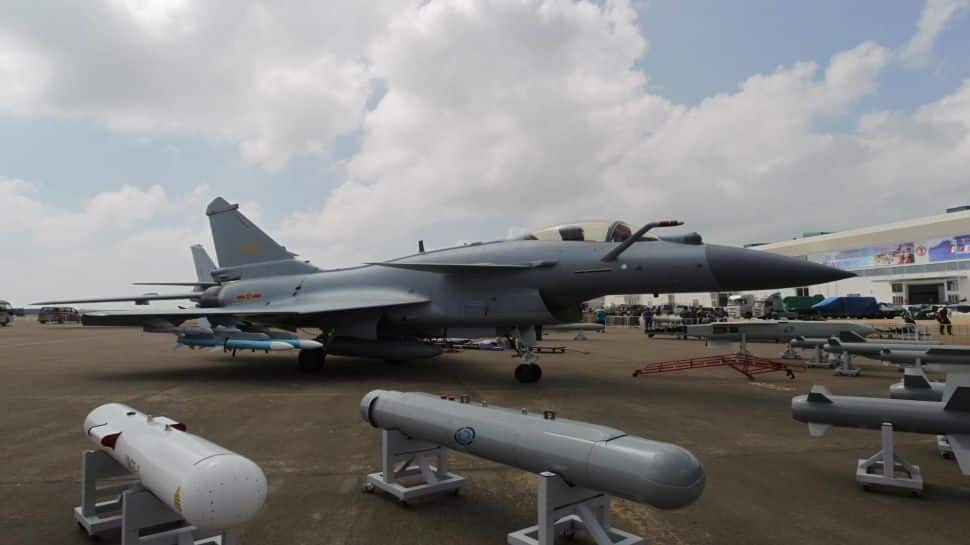
New Delhi: China’s People’s Liberation Army Air Force (PLAAF) is building a new generation of airpower, focussing on stealth, long-range capabilities and networked operations that could alter the balance of air dominance in Asia.
From the J-35 and carrier-ready J-35A to experimental jets such as the J-50 and J-36, as well as the WJ-700 high-altitude drone, a new wave of aircraft is turning heads in global defense circles.
The J-35 family marks Beijing’s entry into true fifth-generation multirole fighters. The land-based J-35 and its naval variant, the J-35A, are expected to perform both strike and limited air superiority missions. Like the U.S.-led F-35, these jets likely operate as sensors in a larger information network, carrying weapons internally to maintain stealth.
The J-35A has been adapted for carrier operations, with reinforced landing gear and corrosion-resistant components, highlighting China’s ambitions for power projection from its growing aircraft carrier fleet.
Complementing these fighters is the KJ-3000 airborne early warning and control platform. Designed for theater-level command, the KJ-3000 provides long-range radar coverage, battlefield management and real-time coordination of fighter and missile defenses. With its expansive radar array and robust datalink capabilities, this aircraft is intended as a force multiplier, supporting both offensive and defensive operations.
China’s experimental J-50 stealth fighter demonstrates a push toward next-generation designs. While it is unclear whether the aircraft is a research prototype or an operational jet, its sleek contours, large internal weapons bay and advanced control surfaces suggest capabilities for penetrating heavily defended airspace.
Analysts believe the J-50 could serve in bomber escort and long-range interception roles, emphasising China’s focus on stealth and versatility.
Meanwhile, the J-36 Chengdu represents China’s heavy and multi-mission fighter, which is optimised for long-range strike and potential command-and-control roles. Its unusual three-engine configuration, tandem cockpit and dorsal air intake indicate a design prioritising range, payload and operational flexibility, including the ability to coordinate with unmanned systems.
Adding a persistent surveillance and strike capability, the WJ-700 HALE drone expands China’s unmanned operations. Capable of carrying air-to-surface munitions and remaining aloft for extended periods, the WJ-700 is visually and operationally similar to US drones like the Reaper and Predator, which provide both intelligence and strike options in contested airspace.
Together, these systems illustrate a layered approach to modern air warfare. Large AEW&C platforms, long-endurance UAVs, and stealth fighters work in tandem to gather intelligence, dominate the skies and enable precise strikes against critical targets. When paired with unmanned “loyal wingmen” aircraft, the effect multiplies, creating a networked battlefield that challenges traditional Western planning.
While debates continue about which generation each aircraft belongs to, China’s air force is steadily becoming stealthier that is capable of striking at longer ranges and increasingly integrated with advanced sensors and weapon systems. The emergence of the PLAAF’s “ghost fleet” indicates that Beijing is not only expanding its air power but is also redefining the dynamics of potential air conflicts across Asia.
About the Author