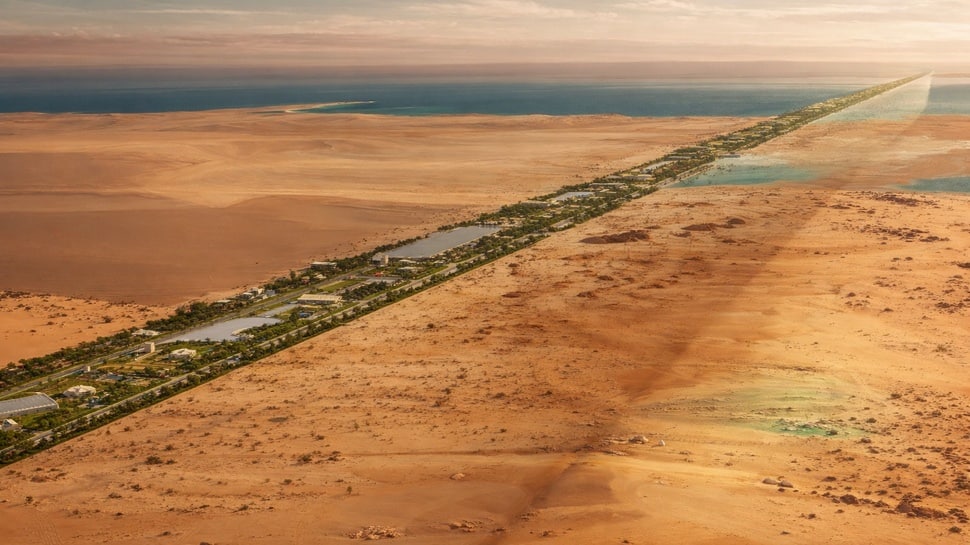
New Delhi: Saudi Arabia has commenced large-scale construction activities on The Line, a planned linear urban development that forms the central component of the NEOM project in the country’s northwest. The project is a flagship initiative under the Kingdom’s Vision 2030 programme, which aims to diversify the economy and reduce long-term reliance on oil revenues through infrastructure, technology, and urban development investments.
The Line is designed as a continuous structure extending approximately 170 kilometres, with a planned width of 200 metres and a height of 500 metres, stretching from the Hejaz Mountains to the Gulf of Aqaba. Satellite imagery and construction data indicate that extensive groundwork has been completed along the planned route, including the excavation of a wide trench and the preparation of foundations across multiple terrain types, such as rocky mountains, desert sands, and coastal plains.
According to project documentation, the initial construction phase has involved the installation of deep foundation systems to ensure structural stability across varied soil conditions. Engineers have employed piled raft foundation techniques, allowing structural loads to be transferred through loose surface materials into underlying bedrock. Phase One construction has included the installation of more than 16,000 concrete piles, some extending up to 70 metres below ground level, reinforced with steel rebar cages and capped by an eight-metre-thick concrete raft.
To support these operations, automated facilities have been established to manufacture large volumes of reinforcement steel components. Drilling rigs guided by GPS technology have been used to precisely bore pile shafts, while stabilising fluids have been applied to prevent collapse during construction. Once installed, concrete is poured to form the load-bearing foundation elements required for vertical development.
Given the project’s proximity to the Red Sea, groundwater management has been a key focus. Project data shows that a large-scale dewatering system has been implemented, involving the drilling of approximately 500 wells along coastal sections of the route. These wells are equipped with pumps that remove saline groundwater at high volumes, directing it to settlement ponds for monitoring before controlled discharge. The system is designed to prevent corrosion of reinforcement steel and long-term degradation of concrete foundations.
Phase One of The Line spans roughly 2.4 kilometres, accounting for less than 1.5 percent of the project’s planned total length. Despite its limited scale relative to the overall concept, this phase includes the construction of several major infrastructure assets intended to anchor future development. These include a marina capable of accommodating large vessels, a stadium with a planned seating capacity of 46,000, and associated structural and transport components. The development is organised into modular sections of approximately 800 metres each, allowing phased construction and independent completion of individual segments.
Project plans indicate that The Line will consist of two parallel rows of towers connected by horizontal decks at multiple levels. Rather than a single continuous structural core, the design incorporates thousands of vertical cores distributed along the length of the structure. These cores are intended to support horizontal decks that will house residential, commercial, healthcare, educational, and transport facilities. Vertical construction is expected to begin following the completion of foundation work, with progress measured by the erection of structural cores and decks.
Infrastructure planning for the project includes integrated transport systems designed to operate without private vehicles. Plans outline a high-speed rail line running beneath the structure, supplemented by mass transit and light rail systems at different levels. Stations are planned at regular intervals to enable movement along and across the structure. Vertical circulation is expected to be provided through elevators and escalators connecting multiple decks.
Water and material supply present logistical challenges due to the project’s scale and remote location. Plans include the development of large desalination facilities and a network of concrete production plants intended to supply construction materials along the project corridor. Some of these facilities are in early development stages, with interim solutions involving local concrete production and water transport currently in use during Phase One.
The Line is intended to serve as the central urban component of the wider NEOM region, which includes multiple industrial, tourism, and technology zones. Timelines for subsequent construction phases and full project completion remain linked to infrastructure readiness, resource availability, and progress toward Vision 2030 milestones. Further updates are expected as the project transitions from foundation works to vertical construction and systems installation.
About the Author