Congress-led INDIA Bloc has only one achievement in its kitty to boast about – stopping the BJP below the 272 mark in the Lok Sabha elections. Since the block has faced consistent dichotomy about its unity. While leaders like Mamata Banerjee and Omar Abdullah have been vocal critics of the INDIA bloc, the Congress party’s poor performance – election after election – has added to the discord.
What is interesting is that now, not only leaders of other parties, but even some Congress leaders feel that the grand old party should chart its own path to survive and end dependency on regional partners. Bihar Congress leader Shakeel Ahmad Khan has now blamed ally Rashtriya Janata Dal (RJD) for the Congress party’s poor performance in the Bihar polls. According to an Indian Express report, he said that Congress should chart its independent course.
A political slugfest erupted after Jammu and Kashmir Chief Minister Omar Abdullah remarked that the opposition’s Indian National Developmental Inclusive Alliance (INDIA) was “on life support” and risked being pushed into the “ICU” due to persistent infighting and its inability to match the BJP’s relentless electoral machinery.
The year 2025 only deepened the erosion of opposition unity. While the INDIA bloc was already on a weak footing at the start of the year, internal conflicts, contradictions, and the clashing egos and ambitions of its leaders further undermined the alliance. The crushing defeat in Bihar proved to be the final blow, widely seen as sounding the death knell for any serious attempt at a cohesive opposition front.
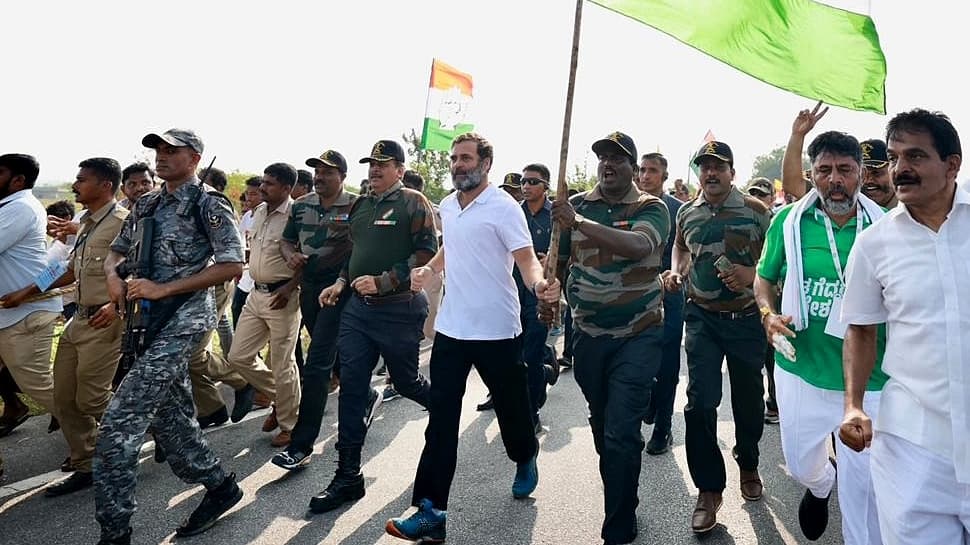
From the opposition’s perspective, the battle increasingly became a solitary one, led almost entirely by the Leader of the Opposition in the Lok Sabha, Rahul Gandhi. Despite sustained efforts, he failed to forge durable unity among alliance partners or restore internal cohesion within his own party. As a result, both Gandhi and the broader opposition are set to enter 2026 on an exceptionally challenging and uncertain note.
Equally striking was the conspicuous absence of several key regional leaders and the INDIA bloc partners from the opposition’s political calculus during the year. Leaders such as Trinamool Congress chief Mamata Banerjee, Nationalist Congress Party (SCP faction) president Sharad Pawar, DMK leader M.K. Stalin, and others remained largely disengaged from any coordinated opposition push. By the end of 2025, what remained was a visibly fractured opposition, struggling to project unity, momentum, or a credible national alternative.
For Rahul Gandhi, persisting with a dysfunctional alliance may now carry greater political cost than benefit. The INDIA bloc has increasingly constrained Congress’s ability to rebuild its organisational base, forcing it into seat-sharing arrangements that weaken cadre morale and blur ideological messaging. Rather than emerging as the natural pole of opposition politics, the Congress has often appeared as just another stakeholder in a coalition driven by regional compulsions. An independent course—while electorally risky in the short term—could allow the party to reclaim political space, sharpen its narrative, and focus on long-term revival without being hostage to allies whose priorities rarely align beyond election arithmetic.
Moreover, dismantling the INDIA bloc could paradoxically strengthen Rahul Gandhi’s leadership standing within his own party. The alliance has offered convenient cover for repeated electoral failures, enabling both Congress leaders and allies to deflect responsibility. A clear break would force introspection, organisational reform, and leadership accountability—elements the party has long postponed. With regional parties already preparing to fight future elections on their own terms, Congress has little to lose by acknowledging the reality of a fractured opposition landscape. In an era dominated by strong, centralised political machines, survival may depend less on artificial unity and more on rebuilding credibility, clarity, and coherence from the ground up.
About the Author