Jawahar Lal Nehru University – a prestigious institution named after the former Prime Minister of India – has been into controversy for all the wrong reasons. The publicly funded institutes shoot into headlines more often, not for its achievements, but for anti-national protests. Two days ago, some students shouted slogans against Prime Minister Narendra Modi and Union Home Minister Amit Shah. While criticism is welcome, instigating or wishing death for the sitting head of state cannot be justified. In their hate against the establishment, the students have started hating the country which is funding their education, which is their motherland.
This is not new for the JNU. The institute has witnessed divisive slogans time and again, including those against Kashmir and pro-terrorists. In 2016, an event on campus relating to Afzal Guru (convicted in the 2001 Parliament attack) prompted clashes. During the fracas, some participants reportedly raised slogans such as “Kashmir ki azadi tak… Bharat ki barbadi tak…” (translated: “War continues until Kashmir’s freedom, war continues until India’s destruction”) and ‘Afzal ham sharminda hai, tere qatil jinda hai’ (Afzal, we are ashamed as your killers are alive). On another occasion, ‘Bharat tere tukade honge, Inshallah, Inshallah’ (India will be broken into pieces, god willing) – slogans were raised.
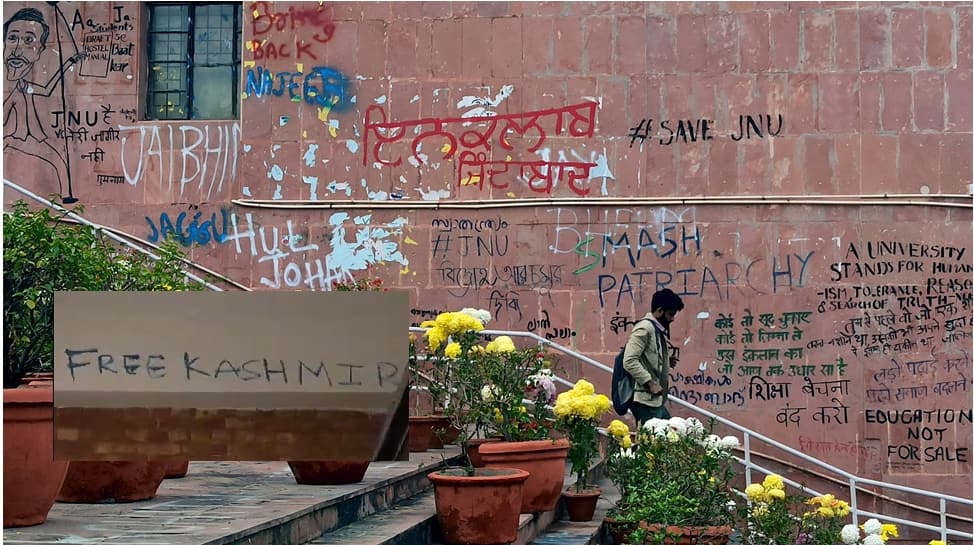
While the university has acknowledged repeated incidents of “anti-national” slogans by forming a committee to look into the issue, including “anti-India” slogans during protests, graffiti with messages like “Free Kashmir,” and other contentious phrases, it has failed to curb the incidents.
Experts Flag Divisive Ideology
Experts are of the opinion that the root cause of such incidents are divisive ideology being indoctrined into the students.
Professor Manoj Sinha, Principal, Aryabhatta College, University of Delhi, said that the JNU sloganeering is a result of an incorrect paradigm of thinking.
“Academics have a tendency to think tendentially from established theorisation. Now, that is a process which has been used by many historically. If there are two ideas, they may clash with each other, and they make a third idea. Then, in the long term, it gets distorted due to personal egos and mediocrity, as when a researcher and thinker has nothing to do, he/she start rebelling against everything. Now, you cannot blame students for this distorted ideology. It’s not that only students are thinking like this, it’s important to know what their teachers are thinking and also, under what culture and way the students are being guided,” said Professor Sinha.
Sangit Ragi, Prof. Sangit Ragi, Delhi University, said that while debates and diverse opinions are welcome, anti-national ideology should not be tolerated.
“Any activity of any student union is free to protest against issues of national importance, including those like unemployment, inflation, or research funding. However, any sloganeering against the nation, like autonomy for Jammu and Kashmir, is not accepted. Universities must take up important issues. If a university is not a place for dialogue, then where should it happen? Discussion and debates must happen and diverse opinions are welcome. But leniency should not be shown to those making anti-national remarks,” said Professor Ragi.
Professor Sinha opined that hate has been cultivated in the students over a period of time, and that is why they are not afraid of going against the nation.
“It is agreed that we have made a state, and it has been done for the convenience of society. This is done to have a peaceful place to live for everyone. If anyone starts creating or promoting violence, then this is not coming from the university but somewhere else. It shows that dissent or hatred has grown to a level where they consider everything wrong, and then they teach students the same thing. This led to the indoctrination of students as they started believing in the same ideology. The JNU sloganeering shows this only,” said Professor Sinha.
Should Taxpayers’ Money Be Used To Fund Such Students?
There has been uproar on social media where netizens express concern over the misuse of their tax money to fund such students with divisive ideology. While taxpayers work hard to earn a living and make the nation prosper by paying taxes, the same money is being used to fund anti-national elements, they feel.
Professor Sinha highlighted that JNU has been a place that has degenerated in the name of freedom of expression and thus, it yields less substance. “There is a culture that they are giving themselves more problems rather than solving outside problems. This also contradicts the growth of the country. What is happening there should be disciplined…JNU is among the 100 per cent government-funded institutions from taxpayers’ money. If taxpayers start asking the government whether they are paying taxes to fund those who think/speak against the nation. On behalf of the citizens, this needs to be acted upon,” he said.
Professor Sangit Ragi said that the government’s money cannot be spent on people who work against the country. “The government must rusticate those involved in such sloganeering, as if they had to do this only, then they should not do it on taxpayers’ money. The authorities must issue a show-cause notice to the involved students after forming a committee and seeking a response within 7 days. If the committee is not happy with their response, then an in-person hearing should be done, and if they fail to issue an apology, then they should be expelled,” he said.
Professor Ragi also said that the judiciary must take these cases very seriously. “The judiciary also needs to think about it. Anyone criticising the judges or judgment faces contempt, but those speaking against the nation get a breather in the guise of freedom of expression,” he said.
About the Author