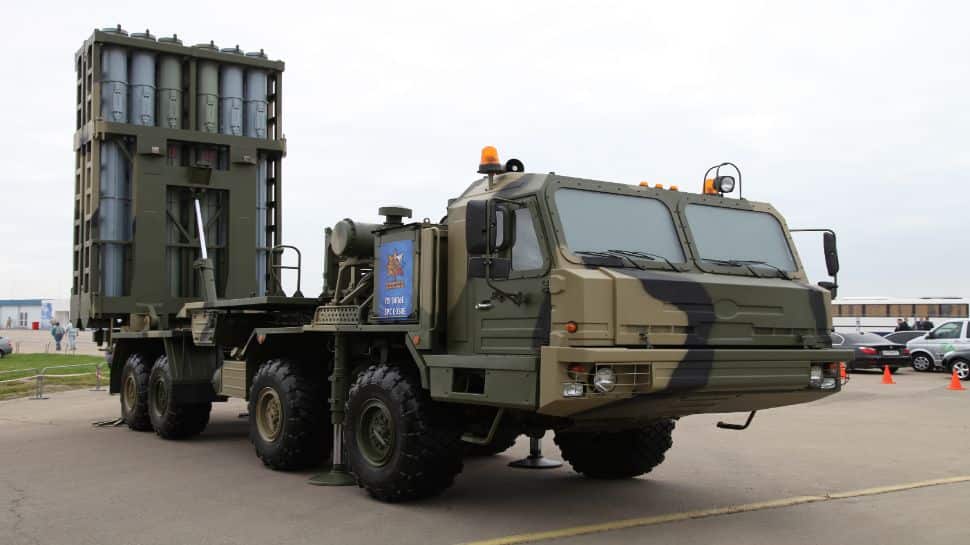
New Delhi: Russia has again offered India the S-350 Vityaz air defence system. The country is presenting it as a strong support system to complement India’s existing S-400 Triumph batteries. The proposal includes full technology transfer, which would allow parts of the system to be manufactured in India. This could strengthen the country’s indigenous defence ecosystem.
With a reported range of up to 120 kilometres, the S-350 can carry 12 missiles on a single launcher and is capable of engaging as many as 16 targets at the same time. Russian officials believe the system would boost India’s ability to counter Pakistan’s cruise missiles and China’s stealth aircraft and drones.
According to Rostec, Russia’s state-owned defence conglomerate, the S-350 is designed to support India’s existing S-400 batteries and plug into the country’s integrated air defence network. The idea is to create a denser and more responsive shield by covering the medium and inner layers of air defence that sit below the long-range reach of the S-400.
During recent high-level talks, discussions also touched upon the possibility of additional S-400 regiments and even the next-generation S-500 system. For now, however, Moscow is positioning the S-350 as the most immediately available and practical option.
India has already operationalised three S-400 squadrons, with two more expected to arrive. Defence planners see the S-350 as an ideal fit for layered protection closer to critical assets.
What Makes The S-350 Vityaz Stand Out
The S-350 Vityaz, which is known internationally as the S-350E export variant, is a modern medium-range surface-to-air missile system developed by Almaz-Antey. It was created to replace the older S-300PS and shows Russia’s latest thinking on mobile and networked air defence.
The system can engage aerodynamic targets such as fighter aircraft at ranges of up to 120 kilometres, while ballistic missiles can be intercepted at distances of around 25 to 30 kilometres. It is designed to intercept threats at altitudes of up to 20 to 30 kilometres.
The S-350 primarily uses 9M96E and 9M96E2 missiles, both equipped with active radar guidance, along with the shorter-range 9M100 missile. Each launcher can carry up to 12 missiles, giving the system a high rate of sustained fire during intense engagements.
One of its key strengths is target handling. The S-350 can simultaneously track and engage up to 16 aerial targets such as aircraft and helicopters or up to 12 ballistic targets. Its multifunction Active Electronically Scanned Array (AESA) radar allows it to detect and engage even low-flying threats that are difficult to spot.
Designed for mobility, the system can be deployed quickly and is effective against cruise missiles, drones, precision-guided munitions and stealth targets. When paired with the S-400, it forms a layered defence structure, with the S-400 covering long-range threats and the S-350 securing medium and shorter ranges.
The system is already part of Russia’s layered air defence doctrine and has demonstrated its effectiveness in real-world conflict environments, including Ukraine.
How It Strengthens India Against Pakistan, China
India faces complex threats along both its western and northern borders. Pakistan and China operate modern fighter aircraft, cruise missiles, ballistic missiles and large drone fleets, creating the need for a dense and flexible air defence shield.
Against Pakistan, the S-350 would be particularly effective in countering low-altitude threats. Aircraft such as the JF-17 and J-10, along with Babur cruise missiles, are designed to fly low to evade radar. The S-350’s radar and missile combination is well suited to neutralising such attacks.
During Operation Sindoor, India’s S-400 systems successfully blocked Pakistani aerial threats. The addition of the S-350 would provide even tighter coverage, especially along sensitive stretches of the Punjab and Rajasthan borders.
On the China front, the challenge is different but equally demanding. China fields J-20 stealth fighters, DF-17 hypersonic missiles and a vast array of long-endurance drones. In high-altitude regions such as Ladakh and Arunachal Pradesh, shorter-range and fast-reacting systems become critical.
The S-350’s ability to engage multiple targets quickly would allow India to build a stronger defensive shield along the Line of Actual Control (LAC). Working along with the S-400, it would also improve India’s ability to manage ballistic and hypersonic threats.
Overall, the S-350 would complete India’s multi-layered air defence architecture, complementing systems such as Akash, Barak-8 and the S-400. Beyond stopping enemy air attacks, it would give the Indian Air Force greater operational freedom by reducing the constant pressure of defensive vigilance.
If the deal goes through, production and maintenance in India would further strengthen domestic defence manufacturing and long-term self-reliance.
About the Author