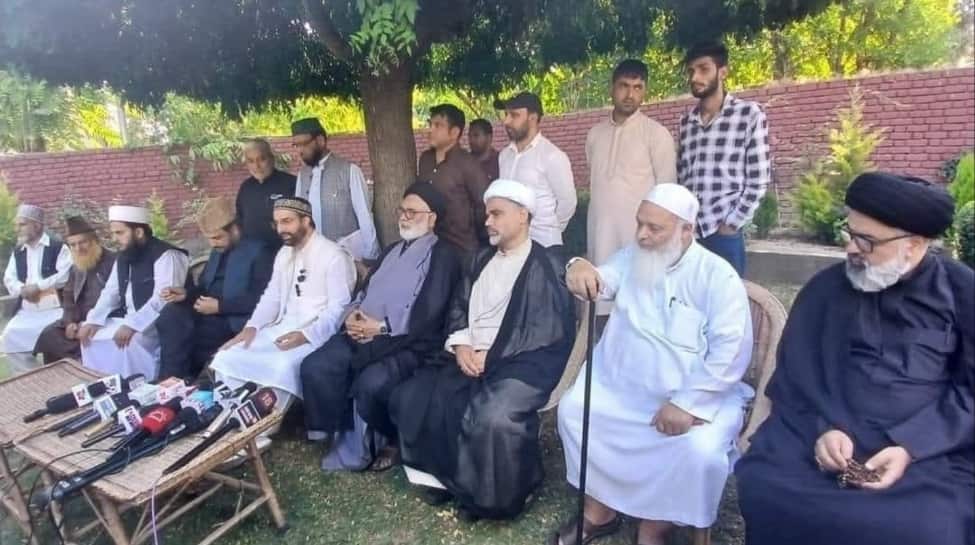
The Mutahida Majlis-e-Ulema (MMU), a conglomerate of Islamic organisations in Jammu and Kashmir led by Mirwaiz Umar Farooq, has raised strong objections to government initiatives related to the national song Vande Mataram, terming them incompatible with Islamic beliefs.
The MMU stated that reciting Vande Mataram is considered “un-Islamic” as the song contains devotional elements that conflict with the Islamic principle of Tawheed, or the oneness of Allah. According to the organisation, Islam does not permit acts that sanctify or deify any created entity, including the motherland.
Earlier, the MMU had criticised a directive issued by the Jammu and Kashmir Department of Culture mandating schools to observe the 150th anniversary of Vande Mataram through various programmes. The group described the move as “coercive” and a violation of religious freedom.
The organisation has now expressed concern over an online Vande Mataram singing competition organised by the Jammu and Kashmir Department of Information and Public Relations (DIPR). Advising Muslims to refrain from participating, the MMU also criticised local newspapers for publishing and promoting the competition’s publicity material.
The MMU alleged that such directives amount to an attempt to impose what it described as an “RSS-driven Hindutva ideology” in the Muslim-majority region under the guise of cultural activities. While reiterating that Islam encourages love for one’s homeland, the organisation emphasised that such love should be demonstrated through service and positive contribution rather than religiously conflicting rituals.
Appealing to Lieutenant Governor Manoj Sinha and Chief Minister Omar Abdullah, the MMU urged the authorities to withdraw the directives, warning that they could cause “anguish” among the Muslim community.
In a handout, the MMU said it had taken serious note of the circulation and promotion of publicity material related to the Vande Mataram singing competition by government departments and its reproduction in local newspapers. The statement reiterated that anthems carrying devotional and theological meanings rooted in non-Islamic belief systems raise serious Shar‘i concerns for adherents of Islamic monotheism.
The MMU advised individuals guided by Islamic teachings to respectfully refrain from participating in such programmes and expressed concern over local newspapers promoting the material without sensitivity to the region’s religious identity. Emphasising that respect for religious conscience is essential for social harmony and coexistence, the organisation appealed to all institutions to exercise greater cultural and religious sensitivity in public communication.
The handout noted that the Mutahida Majlis-e-Ulema comprises prominent religious leaders, including Mirwaiz Umar Farooq, Mufti Azam Nasir-ul-Islam, Maulana Muhammad Rahmatullah Qasmi, Aga Syed Hasan Al-Mousavi Al-Safvi, Dr Adil Latif Al-Kandi, Maulana Ghumal Rasol Ham, Aga Syed Muhammad Haddy, Maula Masroor Abbas Ansari, along with dozens of other Islamic organsions and stalers.
About the Author