India is taking a big step toward full self-reliance in its missile systems. The Pralay tactical quasi-ballistic missile will now use INDIGIS, a fully Indian-made mapping and location system created by DRDO’s Centre for Artificial Intelligence and Robotics (CAIR) in Bengaluru. This upgrade means the missile will depend on Indian technology, not foreign software, to find targets more accurately and work smarter in any battlefield.
The new system will give Pralay missile commanders a safe and powerful digital map that works even without internet. They can clearly see where their own missile launchers are placed, the types of Pralay missiles available, including conventional missiles (for standard strikes) and penetration-aid sub-munition variants (missiles that release many small explosives to break through enemy defences). They can also view how far each missile can reach, areas where the enemy cannot escape, and all target details. Everything is planned with very high accuracy, using Indian software that has no foreign control or hidden risks.
Till now, many Indian systems used for tasks like finding where enemy weapons are placed, deciding which missile to fire and from where, and managing all missile units during a mission depended on foreign-made mapping software taken under licence. But Pralay is a very important missile meant to target high-value sites in Pakistan and China in the early hours of a war. So, the Army and Defence Research and Development Organisation (DRDO) decided that it must use a 100% Indian-made mapping system, with no foreign dependence at all.
After DRDO checked the system internally, the INDIGIS platform from CAIR was given to Microgenesis Techsoft Pvt Ltd, a Bengaluru company, through a commercial transfer-of-technology (ToT) deal, as reported by idrw.org. Microgenesis has now modified and upgraded the INDIGIS software kit to fit Pralay missile needs exactly, making it ready for real military use.
It gives the Army a complete map-making tool on their computers. Units can create uniform, same-style maps (maps that look the same everywhere and follow one standard format) using simple templates. They can also save important locations as bookmarks, making it easy to find and use them quickly during any mission.
Operators can create any number of map layers and use the same fixed symbols for all of them. For example, all Pralay units will see launcher locations (where their own Pralay missiles will be fired from) in the same icon, impact areas (the zone where the missile is expected to hit) in the same shape, and restricted zones (areas where movement or firing is not allowed) in the same colour. This ensures everyone sees the same clear map, with no confusion during a mission.
With INDIGIS now running the planning system for Pralay, India has achieved something special: a fully Indian missile, a fully Indian guidance and seeker system (the part of the missile that searches for and locks onto the target for accurate hit), and now a fully Indian mapping and decision tool. This means the entire Pralay system is 100% Indian-made, with no foreign dependence.
When the first Pralay missile regiments start working with the Army’s Rocket and Missile Forces in 2026–27, their commanders will plan missions using Indian maps, Indian software, and Indian systems, all developed inside India. Very few countries in the world have this level of complete self-reliance in missile planning and operations.
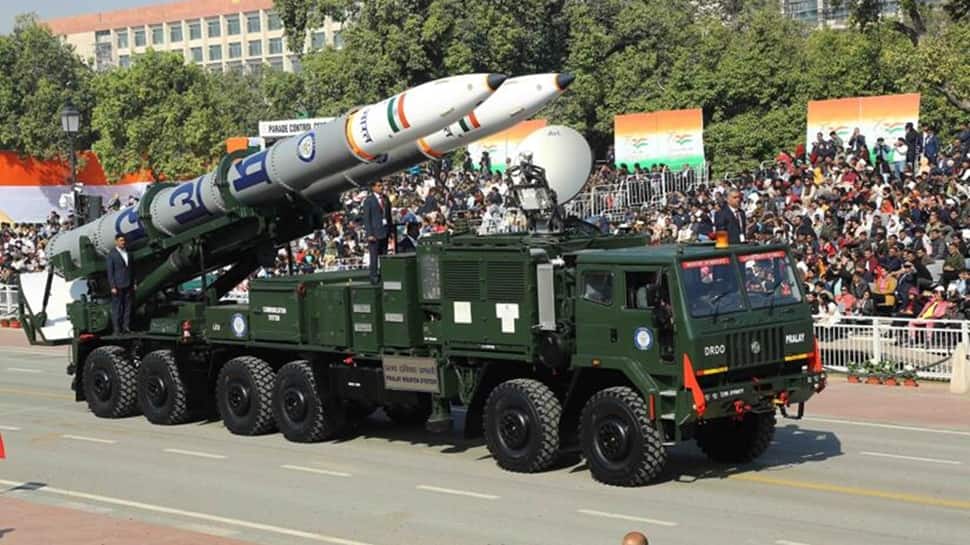
The 150–500 km Pralay missile flies on a depressed quasi-ballistic path (a lower, curved path that is harder for the enemy to detect or stop) and can change direction in mid-flight. It is launched from highly mobile TEL trucks (Transporter-Erector-Launchers, special trucks that carry, lift, and fire the missile), which keep moving so the enemy cannot easily target them. Because of this, commanders need instant view of each TEL’s exact location (so commanders always know where every missile launcher is), live display of missile range for each warhead type (how far each version of Pralay can hit), terrain masking analysis (finding places where launchers can hide from enemy drones and satellites), fast shoot-and-scoot route planning (quick paths to fire the missile and immediately move to safety), and overlay of enemy radar and artillery danger zones (showing where enemy air-defence and counter-fire can reach, counter-fire means enemy guns or missiles fired back at the launch point).
All of this has to run inside the same strong and secure battle-control system, meaning the main computer system that chooses targets, gives firing commands, and manages the entire missile mission. And it must keep working even if enemy forces block or jam satellite signals, so the Army can continue operations without interruption. This is what makes INDIGIS so valuable. It is a complete mission-planning brain that works independently, keeps our secrets safe, and gives our forces the confidence to act decisively when it matters most.
(Girish Linganna is an award-winning science communicator and a Defence, Aerospace & Geopolitical Analyst. He is the Managing Director of ADD Engineering Components India Pvt. Ltd., a subsidiary of ADD Engineering GmbH, Germany.)
About the Author