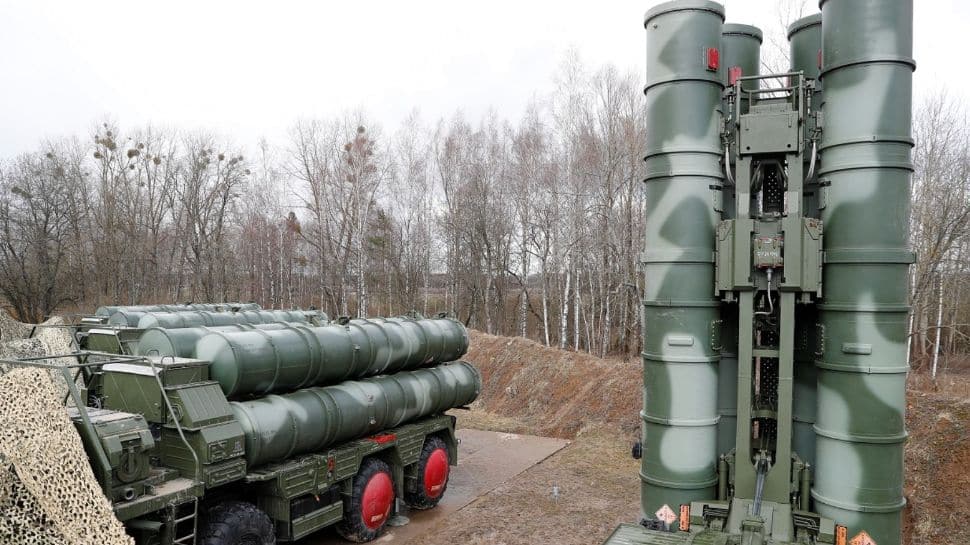
New Delhi: Russian President Vladimir Putin is in India for a two-day visit, and defence cooperation is the main focus of his meetings. Along with talks on the Su-57 fighter jet, the S-500 Prometey air-defence system has become the key subject of discussion. The S-500 is Russia’s most advanced air-defence platform and is among the few systems in the world designed to intercept hypersonic missiles and stealth aircraft.
So, why does India need this system at this point in time?
The answer lies in the vulnerabilities that have begun to trouble India’s security planners. The country is surrounded one of the world’s most hostile neighbourhoods: its Ladakh and Arunachal Pradesh face China and the western front borders Pakistan.
China already deploys hypersonic missiles like the DF-21, weapons that can fly at 10 times the speed of sound. Pakistan has plans to import the hypersonic technology from Beijing.
The shock of Operation Sindoor still hangs in the air. During the India-Pakistan aerial clash, the S-400 performed impressively well by shooting down an Airborne Warning and Control System (AWACS) from a range of 300 km. But the system is not built for hypersonic warfare.
Air Chief A.P. Singh recently said that India needs the next generation of systems capable of stopping the fastest weapons now entering the battlefield.
China’s expanding arsenal adds more urgency. The country fields weapons such as the HQ-19, which can intercept missiles 600 km away. Indian defence analysts warn that if India does not upgrade, major cities like Delhi or Mumbai could eventually be exposed to unprecedented threats.
Other major military powers have already deployed advanced missile-defence systems, such as the United States with THAAD and Israel with the Arrow-3. As these capabilities become standard among leading nations, India needs comparable technology to keep pace, especially when the security landscape in the region is changing rapidly.
At present, India operates four regiments of S-400, with the fifth expected in 2026. But without the S-500, India’s defensive wall against hypersonic weapons remains incomplete.
Known by its NATO designation “Prometheus”, the S-500 is Russia’s newest air-defence system and a major upgrade over the S-400. It entered Russian service in 2021, and Moscow has now prepared an export version for India. It offers a powerful range of 500 km against air attacks and 600 km against ballistic missiles. It can strike targets as high as 200 km above the ground.
Its defining feature is its ability to counter hypersonic threats. It can intercept 10 incoming missiles travelling at 6,000-7,000 km per hour or more, including weapons such as Kinzhal.
Even stealth jets like the Chinese J-20 are detectable. The system can track and destroy up to 18 aircraft or 12 ballistic missiles at once through a 360-degree radar network.
The platform is fully mobile, mounted on trucks and can be made mission-ready within five minutes. Russia tested the S-500 in the Barents Sea exercises, which were observed by teams from the Defence Research and Development Organisation (DRDO) and the Indian Air Force (IAF).
Its single regiment, with eight launchers, costs between Rs 8,000 and Rs 10,000 crore, making it more expensive than the S-400 but far more powerful.
Russia’s Deputy Prime Minister Denis Manturov said at the Dubai Airshow 2025 that discussions on the S-500 are open with countries that already operate the S-400, including India.
India and Russia have shared a defence relationship spanning six decades. They signed the $5.4-billion S-400 deal in 2018 despite the pressure from the Countering America’s Adversaries Through Sanctions Act (CAATSA).
The attention has now shifted to the S-500. The meeting between Putin and Prime Minister Narendra Modi today (December 5) is expected to include detailed negotiations.
India is considering the purchase of two to three regiments, along with an offer for joint production, potentially involving the Hindustan Aeronautics Limited (HAL) or the Bharat Electronics Limited (BEL).
The groundwork for this partnership had been building silently. During Modi’s Moscow visit in July 2024, Russia floated the proposal for a joint manufacturing line. A DRDO delegation travelled to the country in October 2025 to review the S-500’s hypersonic tests.
India and Russia will also discuss additional squadrons of S-400, Su-57 fighters and the BrahMos-2 hypersonic missile. The Russians have promised 100% technology transfer, a commitment that would strengthen India’s Advanced Medium Combat Aircraft (AMCA) project. If all moves as planned, deliveries could begin between 2027 and 2028.
For India, the S-500 promises several advantages. It offers a hypersonic shield that would allow Delhi to defend itself from threats up to 600 km away. It gives India immediate strength at a time when the indigenous ballistic missile defence programme may not be ready before 2030. Joint production opens doors to jobs, technology gains and exports.
Systems like Akash-NG can benefit from this advanced knowledge. The S-500 also keeps India independent by avoiding reliance on American THAAD while offering a more affordable package with technology transfer.
Along the borders, particularly the Line of Actual Control (LAC) and the Line of Control (LoC), the system would reduce aerial vulnerabilities and prove valuable in crises similar to Operation Sindoor.
Experts believe that once India fields the S-500, it will possess the strongest air-defence network in Asia. But the road ahead carries complications. Washington’s CAATSA sanctions still loom large. The U.S. objected even to the S-400, and a stronger Russian partnership may draw more pressure.
The Ukraine war has already slowed Russia’s production timelines, and India remembers the delays in S-400 deliveries. The S-500 is expensive and complex, and integrating it into India’s defence grid will not be simple.
Geopolitical tensions also remain a factor, especially with India’s growing role in the Quad.
If the Putin-Modi meeting concludes with a green light, the contract could be signed in 2026. With that, India will join the small group of nations capable of defending against hypersonic weapons. The IAF will gain a level of capability that it has long awaited.
The move would also push the goal of an Self Reliant India several steps forward. But every decision carries weight, and this one is no exception. Russia remains a steadfast partner, but the world around India is changing fast.
About the Author