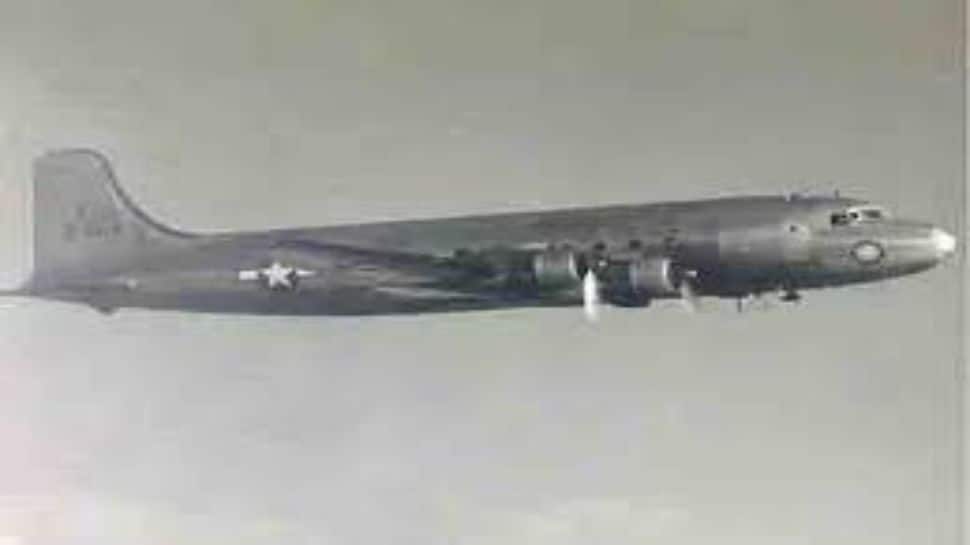
Lost US Air Force Plane: Seventy-five years after a US Air Force transport plane vanished into the Yukon wilderness with 44 people on board, a group of volunteers, researchers and family members is mounting a fresh search. This time, they are relying on artificial intelligence, satellites and technology that did not exist even a few years ago.
A Douglas C-54 Skymaster, the aircraft lifted off from Elmendorf Air Force Base on January 26, 1950. On board were 42 service members and one civilian family, Joyce Espe, who was pregnant, and her toddler son, Victor. Joyce was travelling for medical care.
Two hours into the flight, the crew radioed in with a routine update. Ice was forming on the wings, they said, but everything else appeared normal. That message was the last anyone ever heard.
Neither the Skymaster never reached its next scheduled check-in, nor any distress call followed. The plane disappeared without leaving behind wreckage, debris or survivors.
After weeks of searching that yielded nothing, the US Air Force ended its efforts. The case faded from official memory. But for families, it never did.
Now, environmental biologist Michael Luers, Jim Thoreson of the Civil Air Search and Rescue Association and remote sensing expert Nelson Mattie have joined forces with Project Recover, a nonprofit known for locating missing service members. Together, they believe modern technology can finally solve a mystery that has haunted families for three generations.
The Final Contact Over The Yukon
The last voice to hear from the Skymaster belonged to Clare Fowler, a 22-year-old civilian radio operator stationed in Snag, Yukon. Around 11 p.m., the plane checked in, reporting that everything was fine apart from icing conditions. The next scheduled communication point, Aishihik, lay about 100 miles away. That call never came.
Snag was already infamous for its extreme weather. Three years ago, it had recorded the coldest temperature (minus 81 degrees Fahrenheit) ever measured in North America. The Skymaster was flying unpressurised at 10,000 feet through rugged mountain terrain, leaving little room for error.
Investigators long suspected the plane iced over and crashed, possibly plunging into a glacier and vanishing beneath layers of snow and ice.
Luers understands those dangers firsthand. Years ago, he experienced severe icing on a flight between Iceland and Greenland. He has personally experienced a plane icing over, with giant drops of water freezing on the aircraft, hundreds at a time.
They could not see 10 feet in front of the plane. The ice on the windshield and wings was an inch and a quarter thick. The pilot put them in a nosedive to within 500 feet of the sea, and ice the size of plywood was flying off.
At 500 feet above the water, the aircraft broke through the clouds and survived. That experience, Luers says, has never left him. It fuels his determination to find the Skymaster and the people who never came home.
Why The Military Walked Away
The crash happened during peacetime, creating a bureaucratic gap that still exists today. The Defense POW/MIA Accounting Agency only investigates service members lost in combat. No federal agency is responsible for tracking down those lost in training accidents or routine operations.
In February 1950, the Air Force did launch a search known as Operation Mike, which is named after one of the crew members. Thousands of American and Canadian troops took part, along with more than 25 aircraft. In just three days, search planes covered 88,500 square kilometres in brutal winter conditions. Four aircraft crashed during the operation. All crews survived.
The search overlapped with Operation Sweetbriar, a massive US-Canadian military exercise that brought over 5,000 troops into Whitehorse. The overlap created confusion on the ground.
Locals could not tell the difference between distress calls and military calls. People all over the Yukon thought they saw parachutes or heard the plane, but a lot of information was from military maneuvers.
Then, on February 14, 1950, a US B-36 bomber carrying a nuclear weapon went missing over the Gulf of Alaska. It became the first ‘Broken Arrow’ incident in American history. All available resources were diverted to that crisis. Once the snow melted, the search for the Skymaster was never resumed.
Over time, the story slipped out of public view. The families were left with questions that were never answered.
In 2023, Luers asked former Congressman Chris Stewart of Utah, a retired Air Force B-1 bomber pilot, to press the Air Force to reopen the case.
He made a solid, really hard run at the Air Force to convince them to look. But they did not do it.
The Air Force replied that it would not reopen the investigation without “physical evidence confirming any aircraft discovery or a high potential that remains could be found”.
It was described as a glaring gap in efforts to search for missing service members, where those lost in combat receive sustained attention while many who died in non-conflict incidents have never been taken up as a responsibility by any agency.
A Father Who Never Stopped Searching
Joyce Espe’s husband Master Sergeant Robert Espe had personally put her and their 23-month-old son on the plane. His last words to her were unforgettable. He had told her that if a jump became unavoidable, the baby should be handed to Sergeant Roy Jones, his closest friend, who was also on board the flight.
Robert Espe never saw his wife, son or best friend again. He joined the search almost immediately, boarding one of the first planes out of Whitehorse.
On a Sunday morning, he boarded the first search aircraft to depart the base and spent nearly nine hours in the air searching. He later described how he had endured the hysteria and broken down in tears.
He spent the rest of his life observing birthdays, speaking about his lost family as if they were still alive and writing letters to other families who had lost loved ones on the Skymaster. He later remarried and had two daughters.
One of those daughters, Kathy, married Michael Luers. Though the couple eventually divorced, they were close friends. Kathy often wondered aloud what had happened to her father’s first family.
It was explained that the boy who died in the plane crash was her half-brother and that the effort was not about seeking attention but about locating the aircraft and bringing the 44 lost souls back to their families.
Three Generations Without Answers
Another passenger, Sgt. Junior Lee Moore, had sent a letter home before the flight. It opened with a haunting line, “I guess you thought I had died or something.”
He promised to see his family soon. His nephew, Larry Floyd, was only a few months old at the time of the crash. Another relative, Cpl. Raymond Matheny, was also on the plane. The two men did not know each other and were unaware of their family connection.
It was felt that what troubled the family most was the sudden end of the search and the absence of any serious effort by the government to return and look for the aircraft, leaving the sense that the matter was never treated as a priority.
The loss changed their lives. Floyd’s parents developed a fear of flying. Floyd himself still thinks of his uncle every time he boards a plane. On an Alaskan cruise years ago, he declined a flight excursion into the Yukon.
Now, the renewed effort has brought a sense of hope. He expressed gratitude that the effort was finally underway and said it would bring a sense of closure to know where the crash happened and what caused it.
Why The Plane Stayed Hidden
The Yukon holds more than 500 documented aircraft wrecks. Only a handful is unaccounted for. The Skymaster is the largest of them all.
For decades, volunteers from the Civil Air Search and Rescue Association used the case as a training exercise, flying over the rugged terrain between Snag and Aishihik, an area covering roughly 4,500 square miles.
Thoreson, who spent 32 years in search and rescue, has worked the case since 2008.
He explained that the terrain was extremely harsh and difficult, adding that it was clear from the beginning the wreckage would be hidden under dense tree cover. He felt there was little chance of spotting anything from the air and said that, even after 75 years, simply flying over the area in a small aircraft was no longer sufficient.
Dense forests and the lack of post-thaw searching likely concealed the wreckage. He said that if the aircraft had struck trees and exploded, it would have been quickly covered. And if it went down beneath tree cover, it would not be visible from the air. He added that without scientific methods, the wreckage would never be found.
Technology Offers A New Path
Filmmaker Andrew Gregg stumbled onto the story while visiting a Yukon museum. He began researching the crash and eventually interviewed Clare Fowler, who shared photographs and firsthand details. In 2022, he released the documentary ‘Skymaster Down’.
That film brought attention to the case and led Luers to reconnect with Thoreson.
Over the next year, the team consulted experts and identified tools that could finally make a difference. Nelson Mattie, a Ph.D. candidate at the University of Alberta, stepped in.
He said that a couple of years ago he had contacted experts he identified through various publications on remote sensing, and that Nelson responded saying he would like to help.
The plan combines synthetic aperture radar, multispectral satellite imagery and LiDAR, all analysed by artificial intelligence trained to recognise aircraft debris.
He explained that the size of pixels in multispectral imaging had been reduced to about 15 centimetres, and that if the crash was scattered in pieces, present technology could now detect small bits of aluminum as well as all four engines.
Mattie trained the AI by photographing known crash sites and using drones to capture detailed images of a stored C-54.
He said that, to train the AI to recognise the wreckage, they identified several known crash sites and used them to show the system what it needed to look for.
If strong leads emerge, helicopters will be used to investigate, working with First Nations authorities. A second phase would deploy high-density LiDAR capable of mapping the ground beneath thick forest cover.
The Cost Of Bringing Them Home
Phase One of the search requires about $160,000. A full LiDAR sweep could cost $1.3 million. Vantor agreed to provide satellite imagery at a discounted rate.
To fund the effort, the team launched the Yukon 2469 Mission Funding Campaign through Project Recover.
For Luers, Thoreson and the families, the effort is not about headlines or recognition. It matters for a single reason: to bring their loved ones home to their families.
About the Author