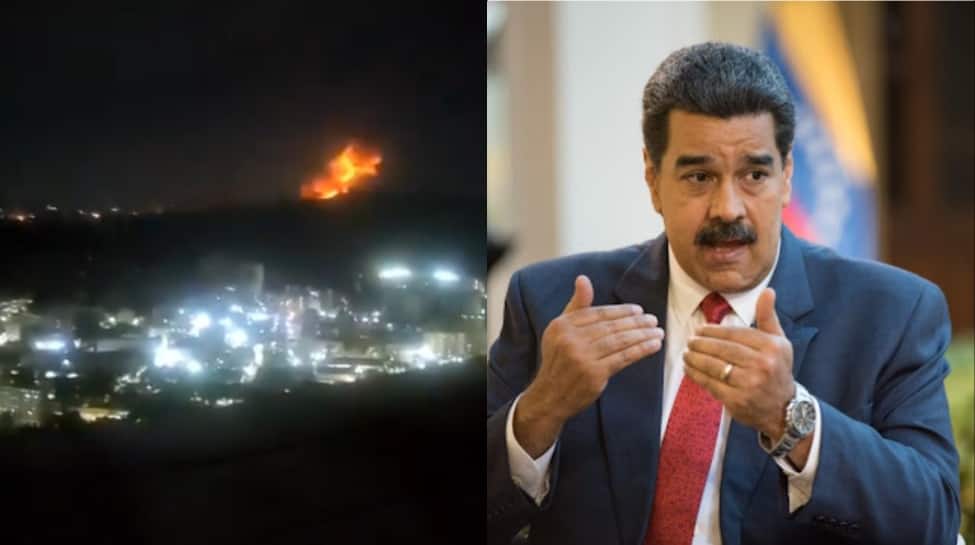
The United States has launched what President Donald Trump described as a “large-scale strike” against Venezuela, claiming that US forces captured President Nicolás Maduro and his wife in a joint military and law-enforcement operation on Saturday. The dramatic announcement followed explosions in Caracas and marks a sharp escalation in months of rising tensions between Washington and the Maduro government.
Residents of the Venezuelan capital reported being woken by a series of loud explosions, with thick black smoke and low-flying aircraft visible over parts of the city. Power outages were reported near military installations, while verified video footage showed tracer fire and smoke both in Caracas and at a coastal site.
Venezuela’s government declared a national emergency and accused the United States of “military aggression”, alleging that both civilian and military sites had been targeted. Officials called on supporters to mobilise, describing the situation as an “external disturbance”.
Posting on Truth Social, President Trump said US forces had carried out a swift operation, capturing Maduro and flying him out of the country. He later told The New York Times that the mission had been carefully planned and praised the troops involved, promising further details at a news conference at his Mar-a-Lago residence in Florida.
Long-Running Tensions
Relations between Washington and Caracas have been strained for years, but pressure intensified in recent months. Trump has repeatedly questioned the legitimacy of Maduro’s government and publicly urged him to leave power, saying earlier this week that it would be “smart” for the Venezuelan leader to step down.
The White House has linked Maduro to three major issues it says threaten US national security: migration, drug trafficking, and what it calls “narco-terrorism.”
Trump has blamed Venezuela’s leadership for the arrival of hundreds of thousands of Venezuelan migrants at the US southern border. Since 2013, when Maduro came to power, nearly eight million Venezuelans are estimated to have fled economic collapse and political repression, most settling elsewhere in Latin America. Without providing evidence, Trump has claimed that Maduro “emptied his prisons and insane asylums” and forced inmates to migrate north, allegations that Caracas has firmly denied.
Drug Trafficking Accusations
The second pillar of Washington’s case concerns drugs. The Trump administration says Venezuela is a key transit route for cocaine and a contributor to the US fentanyl crisis. Two Venezuelan criminal groups, Tren de Aragua and the Cartel de los Soles, have been designated Foreign Terrorist Organisations by the US.
Trump has alleged that the Cartel de los Soles is led by Maduro himself. The Venezuelan president has strongly denied the accusation, arguing that Washington is exploiting the “war on drugs” as a pretext for regime change. Analysts cited by the BBC have noted that the Cartel de los Soles is not a single hierarchical organisation, but a term used to describe corrupt officials who allow cocaine to pass through the country.
The US government says it is engaged in an “armed conflict” with drug cartels operating across the region.
Military Build-Up And Strikes
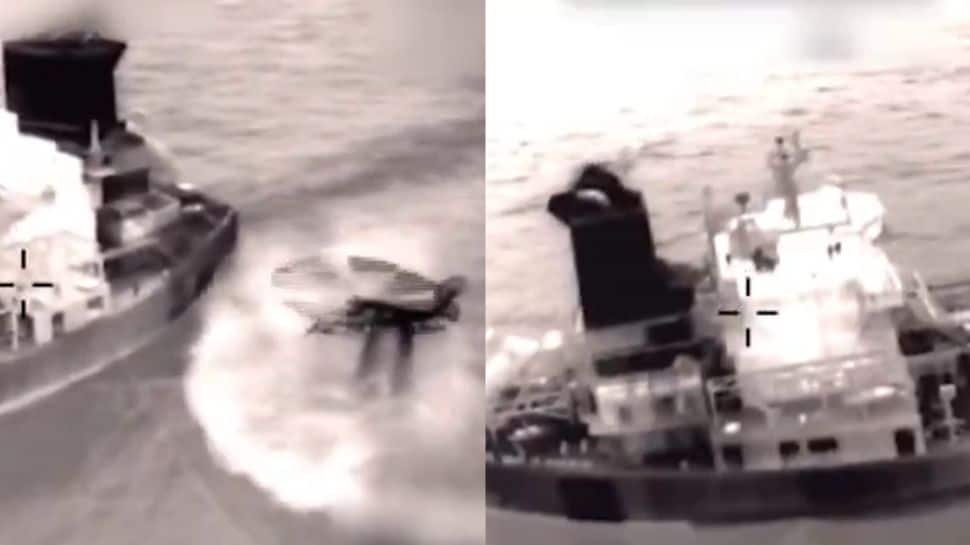
In the lead-up to Saturday’s operation, the US significantly expanded its military presence in the Caribbean, deploying an aircraft carrier, warships, and advanced fighter jets. Washington also pursued an oil blockade on Venezuela, seized two tankers at sea, and expanded sanctions on the Maduro government.
Trump has acknowledged more than two dozen strikes on vessels accused of drug trafficking in the Pacific and Caribbean, claiming that more than 100 people were killed in those operations. Last week, he said US forces struck a Venezuelan docking area used to load boats with drugs — the first publicly confirmed land operation in the country since the campaign began. He did not specify whether the CIA was involved, though media reports have suggested the agency played a role.
International Reaction
Maduro now faces charges of narco-terrorism in the United States. He has accused Washington of seeking to remove him to gain access to Venezuela’s vast oil reserves, pointing to recent offers of cooperation on drug trafficking and migration made shortly before the strikes.
Several countries, including Russia, have condemned the US military action, warning that it risks further destabilising the region.
For now, uncertainty surrounds the situation on the ground in Venezuela, as well as the legal and diplomatic consequences of Washington’s extraordinary claim to have captured a sitting head of state.
About the Author